Serving Ann Arbor Township, MI
Ann Arbor Township MI Wine Cellars | Estate Property Specialists
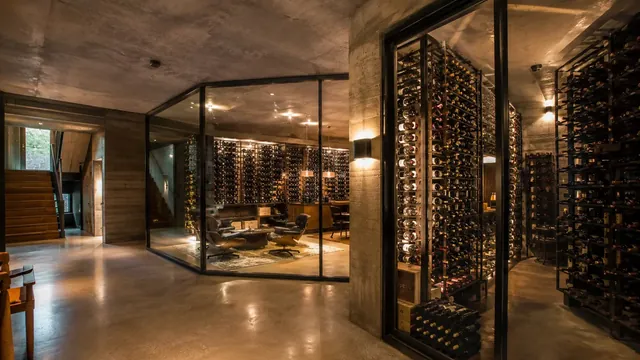
Ann Arbor Township wraps around the city without being part of it, and its housing runs substantially larger than the city stock it borders. Ann Arbor Wine Cellars builds estate-scale cellars here: walk-in rooms holding a thousand bottles and up, glass display walls, ducted split cooling with backup condensers, and integrated tasting areas. The township was organised in 1827 and had 4,673 residents at the 2020 census across nearly 17 square miles, which gives some sense of the lot sizes involved.
Ann Arbor Township MI Wine Cellars
Large lots and large houses remove most of the constraints that shape cellar design elsewhere, which shifts the conversation from what is possible to what is worth doing.
- Estate-scale rooms need floor loading verified before capacity is fixed
- Poured concrete estate basements support large-format racking directly
- Generous lots allow remote condensers well away from living space
- Township contains numerous exclaves, so jurisdiction is worth confirming
At estate scale the floor loading check stops being a formality. A 3,000 bottle cellar introduces around 9,000 pounds of static dead load in bottles alone, before the cabinetry, any stone cladding and the mechanical equipment. We verify the floor construction and span against that figure before fixing a capacity rather than after.
Ann Arbor Township conditions
- Housing
- Estate scale, custom
- Basements
- Poured concrete
- Cooling
- Ducted split with backup
- Typical capacity
- 1,000 to 5,000 bottles
What sets Ann Arbor Township apart for cellar work
The township borders the city and contains numerous exclaves, but the two are administered autonomously. It also administers the village of Barton Hills within its boundaries, and the estate housing across the township reflects that character.
- Estate-scale racking introduces loads measured in tons rather than pounds, so floor verification precedes capacity planning rather than following it.
- Large lots permit condensers to be sited well away from the house, which removes equipment noise entirely without needing acoustic treatment.
- The township's numerous exclaves mean a property's jurisdiction is not always obvious from its address, and it is worth confirming before a permit application.
- Backup cooling is proportionate at this scale, since the value held in a several thousand bottle cellar justifies a second independent circuit.
Ann Arbor Township projects sit at the upper end of our range, and the cost is driven by scale and specification rather than by any difficulty with the buildings themselves.
Where a project involves a glass display wall, ducted cooling, redundant condensers and figured hardwood millwork, each of those is a substantial line in its own right and we itemise them so you can see the trade-offs.
How our work applies in Ann Arbor Township
At estate scale the same services are executed differently, because the loads, the distances and the finishes are all larger.
| Service | What it involves in Ann Arbor Township |
|---|---|
| Custom Wine Cellars | Estate-scale custom cellars from 1,000 to 5,000 bottles. |
| Glass-Enclosed Wine Cellars | Full glass display walls specified to U-0.28 and below. |
| Wine Cellar Backup Cooling Systems | Redundant condensers and automatic transfer for large collections. |
| Wine Cellar Security System Installation | Access control and environmental logging for insured collections. |
| Wine Tasting Rooms | Separate tasting zones alongside estate cold storage. |
| Custom Wood Wine Racking | Figured white oak and mahogany millwork cut to the surveyed room. |
How a Ann Arbor Township cellar project runs
Verify the structure
At estate scale we check floor construction and span against the intended load before any capacity figure is agreed.
Site the equipment
Large lots allow the condenser to go well away from the house, and we walk the site to find the best position.
Build to specification
Ducted cooling, redundancy, glazing and millwork are all delivered to the specification agreed at design stage.
Commission fully
Both cooling circuits are proved independently and the Ann Arbor Township cellar is logged before the collection goes in.
Wine cellar questions from Ann Arbor Township
How big a collection can the floor take?
More than most people expect on a poured concrete basement slab, which is what estate housing here typically has. The check matters more on upper floors or over crawl spaces.
We design to 100 to 150 pounds per square foot and verify the actual construction against the intended capacity before fixing anything.
Should I have backup cooling at this scale?
We would recommend it. At several thousand bottles the value at risk justifies a second independent cooling circuit and, at minimum, remote monitoring.
Monitoring alone is inexpensive and is the highest value single addition regardless of whether you add redundancy.
Can the condenser be completely inaudible?
On a large lot, yes. Siting the condenser well away from the house removes the noise question entirely, which is one of the real advantages of building here.
The limit is the line set run, which is about 100 feet practically, and we size the equipment for the actual distance.
Do I need to be present while you build my cellar?
No, beyond the survey and the elevation approval. Estate builds involve more decisions, so we schedule a weekly walkthrough rather than calling you each time something comes up.
That has proven to be the least disruptive approach on longer projects.
Do you offer free quotes for wine cellars in Ann Arbor Township?
Yes, including the site visit and a written quote itemised by trade so you can see where the money goes.
Call 734-415-4984 to arrange a survey.
Is my property in the township or the city?
It is worth confirming, because the township contains numerous exclaves and the boundary is not always intuitive from an address.
We establish jurisdiction before applying for any mechanical permit rather than assuming from the postal address.
Can you build a cellar during a whole-house renovation?
Yes, and it is much the best time. Coordinating with the other trades means the cellar circuit, the line set route, any structural reinforcement and the mechanical space are all planned rather than worked around.
We coordinate directly with your architect and general contractor, and the cellar typically costs less than the same room retrofitted later.
Practical notes for Ann Arbor Township projects
Estate work in the township raises a few points that smaller projects never do.
- The township contains numerous exclaves, so we confirm jurisdiction against the parcel rather than the postal address before applying for a permit.
- Generous lots mean the condenser can usually go somewhere neither seen nor heard, which removes a constraint that shapes designs elsewhere.
- At estate scale we verify floor construction against the intended load before agreeing a bottle count, because the numbers involved are measured in tons.
Estate cellars where the constraints are yours, not the building's
Tell us what you want the room to be and we will verify the structure can carry it.