Core services
Wine Cellar Flooring Installation in Ann Arbor, MI | Floors That Survive 60% Humidity
Cellar floors fail for one reason more than all others combined: someone laid a finish over a concrete slab that was still giving off moisture. Ann Arbor Wine Cellars tests slabs before specifying anything, using calcium chloride testing to ASTM F1869 or relative humidity probes to ASTM F2170, because a slab on grade in Washtenaw clay can read acceptable at the surface and be well above tolerance three inches down. Above that slab we lay stone, porcelain, terracotta or engineered timber, all of which handle 60 percent relative humidity indefinitely.
Wine Cellar Flooring Installation Ann Arbor MI
A cellar floor spends its whole life at 55 degrees and 60 percent humidity, which is a set of conditions that destroys solid hardwood and laminate and does nothing at all to stone.
- Slab moisture tested to ASTM standard before any finish is specified
- Materials limited to those stable at sustained 60 percent humidity
- Vapour-impermeable underlayment where the finish requires it
- Rack base plates isolated from the floor finish so neither telegraphs the other
Solid hardwood is the material people most often want and the one we most often talk them out of. At 60 percent relative humidity a solid plank floor will take on moisture, expand across its width and either cup or push against the perimeter. Engineered timber with a stable multi-ply core handles the same conditions without moving, and reads identically.
The usual approach
Solid hardwood laid over an untested slab, cupping across every board by the second summer, with the rack base plates now sitting on an uneven floor.
How we do it
A moisture-tested slab, a vapour-impermeable underlayment where needed, and a finish specified to be dimensionally stable at cellar humidity.
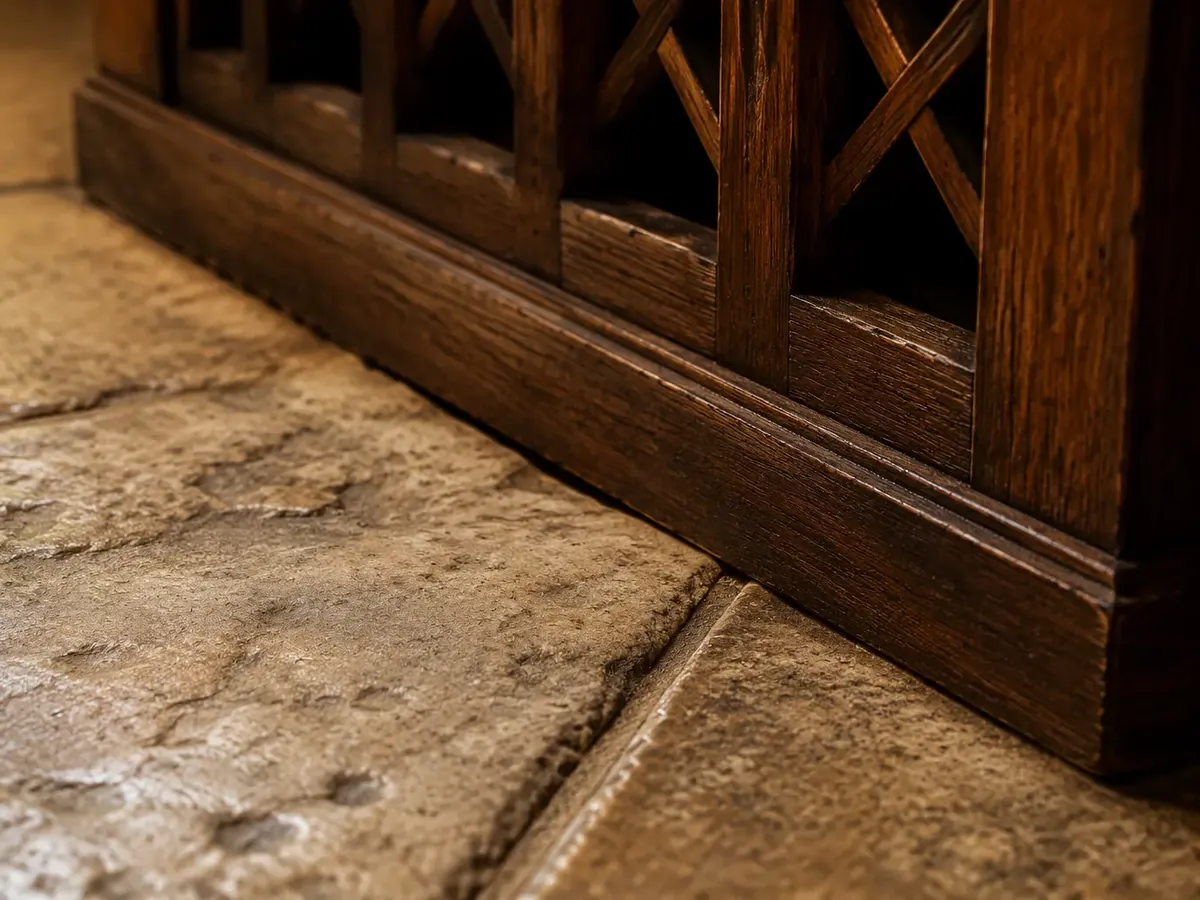
Flooring specification
- Slab testing
- ASTM F1869 or F2170
- Suitable finishes
- Stone, porcelain, terracotta, engineered
- Unsuitable
- Solid hardwood, laminate, carpet
- Ambient
- 55°F at 60% RH, permanent
What actually matters in cellar flooring
Cellar flooring is judged over years rather than at handover, and the two things that determine how it ages are what is underneath it and how stable the material is in humidity.
- Concrete slabs on grade continue to release moisture for a long time, and Washtenaw clay soils keep the underside of that slab damp permanently, so testing is the only way to know what you are laying onto.
- Epoxy coatings and vapour-impermeable tile underlayments trap any moisture the slab is still giving off, which is precisely why the test comes before the specification rather than after.
- Stone and porcelain add useful thermal mass to a cellar, which helps smooth out short temperature cycles between cooling runs.
- Rack base plates concentrate the entire load of a filled rack wall onto a narrow footprint, so the floor finish under them has to be rigid rather than a floating system.
Flooring cost tracks the material more than the labour, with porcelain at the accessible end, natural stone in the middle and reclaimed or wide-plank engineered timber at the top. Underlayment and levelling are usually the hidden variables.
Where a slab tests high for moisture, remediation adds cost before any finish goes down. That may be a moisture-mitigating coating or, occasionally, a decision to use a finish that tolerates the moisture instead.
Before we lay your cellar floor
Flooring is one of the last things installed and one of the first things to suffer if the room is not ready, so a few checks matter.
- Allow time in the schedule for the slab test itself. Calcium chloride testing runs for 72 hours and relative humidity probes need to equilibrate, so this cannot be done the morning work starts.
- Get the cellar to operating temperature before timber flooring is delivered. Engineered board still needs to acclimatise to 55 degrees and 60 percent humidity before it is laid.
- Confirm the finished floor height against the door threshold. Stone over an underlayment adds real height, and a drop seal needs a specific clearance to work.
- Decide whether the floor runs under the racking or stops at it. Running underneath looks better and costs more, and it is much harder to change once base plates are fixed.
Floor loading and flooring are separate questions.
Our cost guide covers where structural reinforcement enters a cellar budget, which is a different line from the floor finish.
How your wine cellar flooring installation project works
Test the slab
We run a calcium chloride or in-situ relative humidity test to the relevant ASTM standard and wait for the result before specifying anything.
Specify to the result
The floor finish and underlayment are chosen against the tested moisture level and the permanent 60 percent humidity the cellar will run at.
Prepare and level
The slab is levelled and any required moisture mitigation is applied and cured before the finish is laid.
Lay and detail
The cellar flooring is installed, with junctions at rack base plates and the door threshold detailed rather than simply butted.
Wine Cellar Flooring Installation questions we get asked
Can I have hardwood in a wine cellar?
Engineered hardwood yes, solid hardwood no. Solid planks move with humidity and a cellar holds 60 percent relative humidity permanently, which is enough to cup a solid floor within a year or two.
Engineered board with a stable core looks identical and stays flat. It is what we lay whenever a client wants a timber floor.
Is carpet ever acceptable?
No. Carpet in a 60 percent humidity room holds moisture at the fibre base and becomes a substrate for mould, and it is nearly impossible to clean properly if a bottle breaks.
A small rug that can be lifted and dried is a different matter and is perfectly fine.
Do I need to be present while you install my cellar flooring?
No. Flooring is one of the least decision-heavy phases, provided the material and layout were agreed beforehand.
For natural stone we do sometimes ask you to approve the actual pallet, since colour variation between batches is real.
Do you offer free quotes for wine cellar flooring installation?
Yes, though a firm price on a slab-on-grade floor depends on the moisture test result, so quotes will state that clearly rather than hiding a contingency.
Call 734-415-4984 to arrange a visit.
What if my basement floor is not level?
Very common in older Ann Arbor houses, and it gets levelled with a self-levelling compound before the finish goes down. What matters is that the racking sits plumb and the door drop seal has consistent clearance.
Significant slope, more than about an inch over ten feet, may point to a structural issue worth understanding before covering it up.
Does the floor affect cellar temperature?
Stone and tile add thermal mass, which smooths out temperature swings between cooling cycles. That is a modest but genuine benefit.
An uninsulated slab on grade also acts as a heat sink to the soil, which in a Michigan basement usually works in your favour during summer.
What goes wrong, and what we do instead
Cellar floors fail for one reason more than all others combined.
| The mistake | What it causes | What we do instead |
|---|---|---|
| Finish laid over an untested slab | Cupping, lifting and trapped moisture within a season or two | Calcium chloride or in-situ RH testing to ASTM standard before specifying |
| Solid hardwood specified | Boards expanding and cupping at a permanent 60 percent humidity | Engineered timber with a stable core, or stone and porcelain |
| Rack base plates on a floating floor | Point loads concentrated on a system never designed to carry them | A rigid floor build-up under any rack base plate |
Test the slab before you choose the floor
We will run the moisture test first and specify a finish that survives 60 percent humidity.