
Specialty and materials
Wine Cellar Backup Cooling Systems in Ann Arbor, MI | Redundancy That Engages Without You
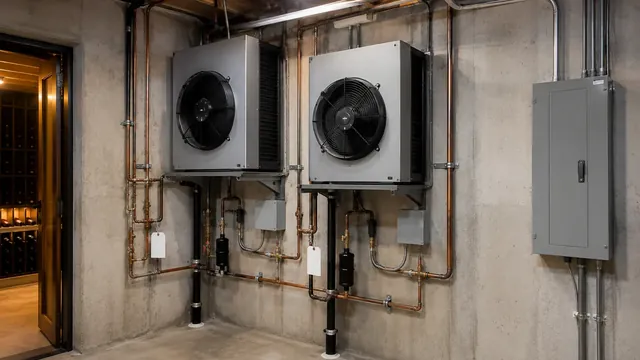
Redundancy is insurance, and how much you need depends entirely on what is in the room. Ann Arbor Wine Cellars installs backup cooling in three layers depending on the collection: a second independent condenser so a compressor failure does not stop the room, an automatic generator transfer switch so a Michigan ice storm outage does not either, and remote monitoring so you learn about a problem from your phone rather than from a warm cellar three days later. Rural Washtenaw County properties in particular see multi-day outages often enough to justify the transfer switch on its own.
Wine Cellar Backup Cooling Systems Ann Arbor MI
The question is not whether cooling will fail, it is whether you will find out in time. A cellar gives no external sign that anything has changed until the damage is already done.
- Second independent cooling circuit rather than a shared-component backup
- Automatic transfer switch so a generator picks up without anyone present
- Remote monitoring that alerts a phone rather than sounding locally
- Alarm thresholds set below the damage point, not at it
A backup that shares components with the primary is not redundancy. Two evaporators fed by one condenser fail together when the condenser fails. Genuine redundancy means two independent circuits, each capable of holding the room alone, ideally with the load split between them in normal operation so both are known to be working.
The usual approach
A single cooling unit and a temperature display nobody checks, discovered at 68 degrees after a long weekend away.
How we do it
Two independent circuits, a generator that starts itself, and a phone alert the moment the room drifts past a threshold you set.
Redundancy specification
- Cooling
- Two independent circuits
- Power
- Automatic transfer switch
- Monitoring
- Remote, phone alerting
- Thresholds
- Set below damage point
What actually matters in backup cooling
Backup systems are only useful if they engage without you. Every layer below is designed around the assumption that nobody is home when it fails.
- Shared components defeat redundancy. Two circuits that both depend on one condenser, one circuit or one condensate pump will fail together.
- A manual transfer switch requires somebody present to operate it, which is exactly the scenario a backup exists to cover, so automatic transfer is the meaningful specification.
- Alarms that sound locally in an empty basement accomplish nothing, which is why remote alerting rather than a local buzzer is the standard we install.
- Well-insulated cellars, particularly below-grade ones, drift slowly, which means a monitored alert usually gives you a day or more of margin rather than an hour.
Backup cooling is layered so you can buy the protection that matches your exposure. Remote monitoring alone is inexpensive and is the single highest-value item, because it converts an unnoticed failure into a manageable one.
A second independent cooling circuit roughly doubles the mechanical cost of the room, and an automatic transfer switch adds licensed electrical work plus the generator itself. We price the layers separately rather than as a package.
Before we install backup cooling
Redundancy work is mostly electrical planning, and the decisions are about how much protection is proportionate to what is in the room.
- Establish the value of what is at risk, honestly. Full redundancy is expensive and is not proportionate for every collection, and we would rather size the protection to the actual exposure.
- Check whether you already have or plan a standby generator. Adding a cellar circuit to an existing generator is far cheaper than installing one for the cellar alone.
- Find out your outage history for your specific address. Rural townships in western Washtenaw County see materially longer outages than city addresses, and that changes what is worth installing.
- Decide who receives the alerts and confirm they will act on them. A monitoring system pointed at an email nobody reads is the same as no monitoring at all.
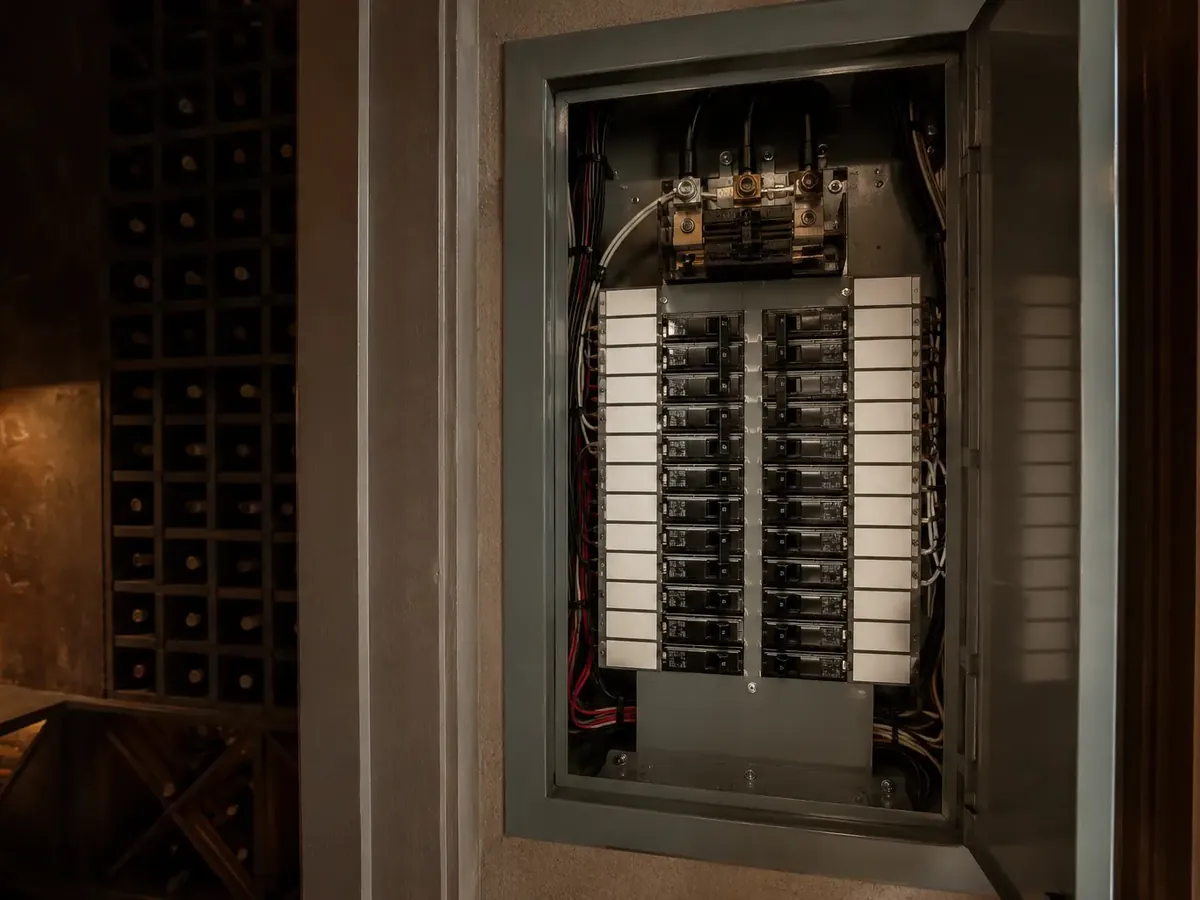
Backup circuits and generator inlets are code-governed.
Our permits and codes guide covers the NEC 2023 requirements for dedicated cellar circuits and transfer equipment.
How your wine cellar backup cooling systems project works
Assess the exposure
We look at what is in the room, your outage history at that address, and how often the property is unoccupied before recommending a level of backup.
Monitor first
Remote monitoring goes in first regardless of budget, because knowing about a failure is worth more than any single hardware layer.
Add redundancy
A second independent cooling circuit is installed where the collection justifies it, sharing no components with the primary.
Wire the transfer
Where a generator is in scope, an automatic transfer switch is installed by a licensed electrician and the backup cooling changeover is tested under simulated failure.
Wine Cellar Backup Cooling Systems questions we get asked
How long will my cellar hold temperature without power?
A well-insulated below-grade cellar typically drifts only a few degrees over 24 hours if the door stays shut, because the surrounding soil and the bottles themselves hold a great deal of thermal energy.
An above-grade room with glass loses temperature considerably faster, often reaching a concerning point within a day.
Is a generator worth it for a wine cellar alone?
Rarely for the cellar by itself. It becomes worthwhile when the same generator also covers your sump pumps, refrigeration and heating, which is the usual case.
In rural Washtenaw townships with a history of multi-day outages, and a collection of real value, the case is much stronger.
Do I need to be present while you install backup cooling?
For access, and briefly for the transfer test. We simulate a failure and confirm the changeover works, and it is worth seeing that happen.
Beyond that the work is contained to mechanical and electrical spaces.
Do you offer free quotes for backup cooling systems?
Yes, and we quote each layer separately so you can start with monitoring and add redundancy later rather than facing an all-or-nothing decision.
Call 734-415-4984 to discuss what is proportionate for your collection.
What temperature should the alarm be set at?
Below the point where damage begins rather than at it. We normally set an alert a few degrees above the setpoint, which gives real warning while avoiding nuisance alerts from a door being held open.
A second, higher threshold as an urgent alert is worth configuring as well.
Can monitoring be added to an existing cellar?
Yes, easily, and it is the cheapest meaningful improvement you can make to any cellar. A monitored sensor needs power and a network connection and nothing else.
It does not require touching the cooling system, so it is straightforward to retrofit into a finished room.
How do I know my backup system still works?
By testing it, which is why we simulate a failure at handover and repeat that test at each annual service. A backup circuit that has sat idle for three years is an assumption rather than a system.
Where the load is split between two circuits in normal operation, both are proven continuously by the fact that the room is holding temperature, which is one reason we prefer that configuration.
What goes wrong, and what we do instead
Backup systems are only useful if they engage without you, which is the scenario they exist for.
| The mistake | What it causes | What we do instead |
|---|---|---|
| Two evaporators fed by one condenser | Both circuits failing together when the shared component fails | Two genuinely independent circuits sharing nothing |
| Manual transfer switch | Somebody has to be home to operate it, which defeats the purpose | Automatic transfer so the changeover happens unattended |
| Local alarm in an empty basement | A failure nobody hears for the length of a weekend away | Remote alerting to a phone, with thresholds set below the damage point |
Find out before the room does
Start with monitoring, then add the redundancy your collection actually justifies.