Cellar types and styles
Glass-Enclosed Wine Cellars in Ann Arbor, MI | Insulated Glass That Stays Dry
Glass is the hardest part of a cellar to get right. It is the bit everyone wants most of, and it is also where the cold escapes and the summer heat gets in. Ann Arbor Wine Cellars builds glass enclosures using dual or triple-pane insulated glass units with Low-E 366 coatings, warm-edge spacers and argon fill, specified to a whole-unit U-factor of 0.28 or better and a solar heat gain coefficient at or below 0.25. Those are not decorative numbers. Single-pane glass in a 55 degree cellar facing a Michigan summer will run with condensation, pool water on the floor, and drive the cooling unit into continuous operation until it fails.
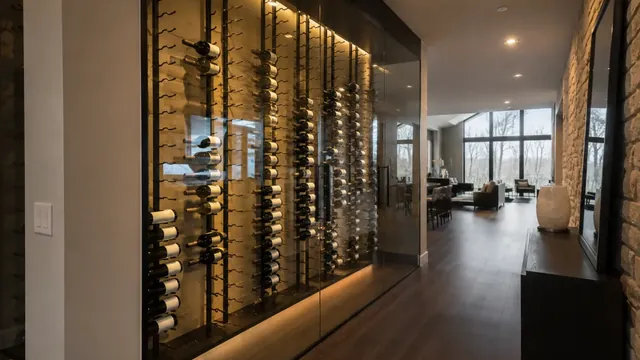
Glass-Enclosed Wine Cellars Ann Arbor MI
Everything about a glass cellar follows from one question: will the interior face of the glass stay above the dew point of the room outside it? Get that right and the enclosure is trouble free. Get it wrong and no amount of cooling capacity will fix it.
- Dual or triple-pane insulated glass units, never single glazing
- Low-E 366 coating with argon fill and a warm-edge spacer
- Thermally broken frames so the metal itself does not become a cold bridge
- Orientation checked against solar gain before the glass is specified
Washtenaw County summer dew points regularly reach 70 degrees. If the interior surface of your glass sits below that, water condenses on it, and it does so on the outside face where everyone can see it. A properly specified insulated unit keeps that surface warm enough to stay dry, which is why the U-factor specification matters more than the thickness of the glass or the look of the frame.
The usual approach
A single-pane glass wall specified for looks, sweating from June to September, with towels on the floor and a cooling unit running around the clock.
How we do it
An argon-filled Low-E 366 unit at U-0.28 with a thermally broken frame, dry through a Michigan August, with the cooling unit cycling normally.
Glazing specification
- Glass type
- Dual or triple-pane IGU
- Coating
- Low-E 366, argon fill
- Whole-unit U-factor
- 0.28 or lower
- SHGC
- 0.25 or lower
What actually matters in a glass cellar
Glass enclosures fail at the edges and at the frame far more often than they fail in the middle of the pane, because that is where the thermal bridges are.
- A conventional aluminium spacer between panes conducts heat straight around the edge of the unit, which is why perimeter condensation shows up first even on double glazing. A warm-edge spacer is the fix.
- An untreated metal frame is a continuous cold bridge from inside the cellar to the room outside it, and will condense along its whole length regardless of how good the glass is.
- Orientation drives solar load. A west-facing glass cellar in a Scio Township walkout takes a very different afternoon heat load from a north-facing one in the same house.
- Glass carries no insulation value worth speaking of compared with an insulated wall, so a glass-fronted cellar always needs more cooling capacity than the same room with a solid wall.
Glass cellar pricing is dominated by the glazing package rather than by anything else in the room. The difference between a single insulated door and a full height, full width glass wall is often larger than the cost of all the racking behind it.
Triple glazing is worth the premium in two situations: a west or south-facing enclosure taking direct summer sun, and any enclosure where the surrounding room is not itself air conditioned. Elsewhere a well-specified double unit is sufficient.
Before we install your glass enclosure
Glass is heavy, made to order and unforgiving of a structure that moves. These are the checks worth making before we order anything.
- Confirm the opening is structurally stable and not still settling. Large insulated units are set to tight tolerances and a frame that shifts after installation will stress the seal.
- Measure the delivery path for the largest single pane. A 9 foot insulated unit weighs several hundred pounds and cannot be turned through a standard stairwell, so occasionally the glass has to come in before an adjacent wall is closed up.
- Note which direction the enclosure faces and whether afternoon sun lands on it. That determines the solar heat gain coefficient we specify and sometimes the decision to go triple-pane.
- Decide on the frame finish early. Thermally broken frames come in a limited palette and a custom powder coat adds several weeks to a component that is already the long pole in the schedule.
Glass adds real load to a cooling calculation.
See how we account for glazing area in our cooling sizing guide before you decide how much of your cellar should be glass.
How your glass-enclosed wine cellars project works
Dew point check
We measure the conditions in the room outside the proposed glass enclosure and confirm what surface temperature the glazing has to maintain to stay dry.
Glazing specification
The insulated unit is specified to a U-factor and SHGC that satisfy that check, and the frame is selected with a thermal break to match.
Structural opening
The opening is framed, squared and confirmed stable, and the frame is set before the glass enclosure is glazed.
Glaze and balance
Units are set and sealed, then the cooling is rebalanced for the additional load the glass introduces and the enclosure is monitored through a full cycle.
Glass-Enclosed Wine Cellars questions we get asked
Why is my existing glass cellar door sweating?
Almost always because it is single glazed or because the frame has no thermal break. Water condenses on any surface sitting below the dew point of the air touching it, and in a Michigan summer that dew point is often around 70 degrees.
The fix is replacing the unit with an argon-filled insulated one at U-0.28 or better. Adding cooling capacity makes the problem worse, not better, because it lowers the glass surface temperature further.
Can a whole wall be glass?
Yes, and it is one of the most striking things you can do with a cellar. It does mean accepting a materially higher cooling load, and it means the cooling equipment gets sized for that load from the outset.
We normally recommend keeping at least one full wall solid and insulated so there is somewhere to mount racking that is not fighting a thermal bridge.
Do I need to be present while you install my glass enclosure?
Not for the whole install, but we do ask that someone is available on glazing day. Setting large insulated units requires clear access and we may need doors held open or a vehicle moved.
The rest of the work, including framing and sealing, does not require you there.
Do you offer free quotes for glass-enclosed wine cellars?
Yes. For glass work the quote includes the specific glazing specification we intend to use, with the U-factor and SHGC stated, so you can see what you are buying rather than just a line saying insulated glass.
Call 734-415-4984 to arrange a measure.
Does glass make the cellar less stable in temperature?
It makes it work harder, but a correctly sized system holds the same 55 degree target with the same tolerance. The difference shows up in run time and in equipment sizing rather than in the temperature you achieve.
What glass genuinely does change is recovery time after the door is opened, since there is less thermal mass in the envelope.
Can you retrofit glass into an existing solid-walled cellar?
Usually yes, provided the wall you want to open is not load bearing or can be headed off. The complication is the vapour barrier, since cutting an opening breaches the continuous plane and it has to be re-established around the new frame.
We also recheck the cooling capacity, because replacing an insulated wall with glass increases the load on a system that was sized without it.
What goes wrong, and what we do instead
Glass enclosures fail at the edges and the frame far more often than in the middle of the pane.
| The mistake | What it causes | What we do instead |
|---|---|---|
| Single-pane glass specified for looks | Condensation from June to September and a cooling unit that never cycles off | Dual or triple-pane insulated units at a whole-unit U-factor of 0.28 or lower |
| Conventional aluminium spacer inside the unit | Perimeter condensation even on double glazing, because heat conducts round the edge | Warm-edge spacers with argon fill as standard |
| Untreated metal frame | A continuous cold bridge that condenses along its whole length | Thermally broken frames, isolated from the surrounding structure |
Glass that stays dry through a Michigan August
We will check the dew point in the adjoining room and specify glazing that holds up to it.