
Guide
Wine Cellar Permits & Codes in Ann Arbor and Washtenaw County | What Applies, and When
Wine cellars sit across three separate codes, and the electrical requirement in particular is the one most often missed by general remodellers. Ann Arbor Wine Cellars handles permit applications as part of our projects, but you should know what applies to your own build regardless of who does the work. This page covers the codes in force, what typically needs a permit, and where historic district review can affect a project that is otherwise entirely interior.
Which parts of a wine cellar are regulated
This page is general information rather than legal or regulatory advice, and requirements change. For anything specific to your property, confirm with the City of Ann Arbor Building Department or the Washtenaw County Building Inspection office, whichever has jurisdiction over your address.
Three separate codes typically apply to a residential wine cellar in this county. Framing, thermal envelope work and any structural modification fall under the 2021 Michigan Residential Code. Electrical work falls under the 2023 National Electrical Code as adopted in Michigan. Refrigeration work involving line sets through exterior walls generally requires a mechanical permit, and any handling of refrigerant requires EPA Section 608 certification.
Interior conversions
Converting an existing basement room typically involves framing, insulation, a new dedicated circuit and a cooling installation. The electrical and mechanical elements are the parts that most often require permitting. Whether the framing itself does depends on the scope and the jurisdiction.
Additions
A cellar addition changes the footprint of the building and requires a full building permit without exception, with structural, electrical and mechanical inspections. This is not a grey area. An unpermitted addition creates a genuine problem at resale and can, in the worst case, force removal.
Codes that apply
- Building
- 2021 Michigan Residential Code
- Electrical
- 2023 NEC as adopted
- Mechanical
- Permit for exterior line sets
- Refrigerant
- EPA Section 608 certification
- Authority
- City or county, by address
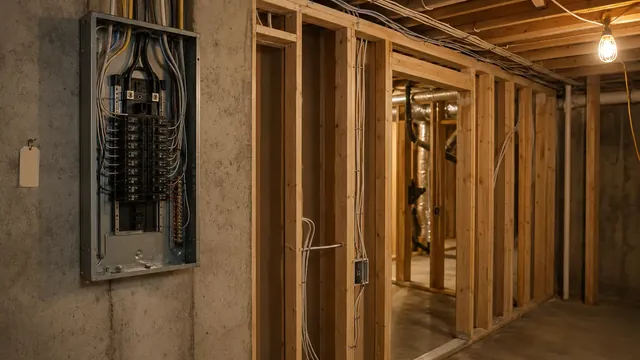
Electrical requirements for a cellar circuit
This is the requirement most often missed on cellars built by general remodellers rather than specialists, and it matters because it is a safety provision rather than a formality.
- Cellar refrigeration units, active humidifiers and LED driver circuits require a dedicated 120V 20 amp circuit rather than sharing a general basement circuit.
- That circuit requires both arc-fault (AFCI) and ground-fault (GFCI) protection under the current code.
- Wiring passing through moisture-heavy zones must use UF-B cable or sealed conduit rather than standard NM cable.
- Where the existing panel has no spare capacity, a subpanel is required, and that is licensed electrical work in its own right.
Older cellars in Ann Arbor and Ypsilanti frequently predate the current AFCI requirements. Where we are servicing or renovating an existing room, we check the circuit protection before reconnecting anything, and we will tell you if it falls short of current standards even when that is not what you called us about.
Mechanical permits and refrigerant handling
Running a refrigerant line set from a cellar through an exterior wall to an outdoor condenser generally requires a mechanical permit. Both the City of Ann Arbor Building Department and Washtenaw County Building Inspection have processes for this, and which applies depends on whether your property sits inside a city boundary or in a township.
| Work | Permit generally required | Notes |
|---|---|---|
| Interior framing only | Varies by scope | Confirm with the relevant authority |
| New dedicated circuit | Yes, electrical | Must be AFCI and GFCI protected |
| Line set through exterior wall | Yes, mechanical | Both city and county require this |
| Refrigerant charging | Not a permit, but certification | EPA Section 608 required |
| Cellar addition | Yes, full building permit | Structural, electrical and mechanical inspection |
| Structural modification | Yes | May require a licensed structural engineer |
EPA Section 608 certification is a federal requirement for anyone handling refrigerant, and it is worth asking about before letting anyone open a sealed system in your house. We hold it, and any refrigeration contractor working on your cellar should be able to show it without hesitation.
Historic district considerations
Several neighbourhoods in our service area sit within designated historic districts, and that can affect cellar work even though the cellar itself is interior. The Ypsilanti Historic District, listed on the National Register in 1978 with an addition in 1989, takes in roughly 400 contributing structures across the Michigan Avenue corridor and Depot Town. The Chelsea Commercial Historic District contains 61 contributing structures on and near Main Street.
Interior work is generally outside the scope of district review, which focuses on what is visible from the public way. Where it does apply to a cellar project is anything on an exterior elevation: a condenser unit mounted on a visible wall, a line set penetration, or a new window or vent. We plan condenser locations with that in mind from the outset and will flag during the consultation if your property is likely to need review.
Confirm before you build, not after
We handle permit applications as part of our projects, and we establish which authority has jurisdiction over your address before applying. If you want to talk through what your specific project needs, our consultation covers it at no cost.
Permit and code questions
Do I need a permit for a basement wine cellar?
The electrical and mechanical elements usually do. A new dedicated circuit requires an electrical permit, and running a refrigerant line set through an exterior wall generally requires a mechanical permit.
Whether the framing itself requires one depends on the scope and on whether your address falls under the City of Ann Arbor or Washtenaw County. We confirm this before applying rather than assuming.
What happens if my cellar was built without permits?
It is more common than you might expect, particularly on cellars built in the 1990s and 2000s. The practical consequences show up at resale, when a buyer's inspector notices unpermitted work.
The electrical is the part worth checking regardless of paperwork, since an unprotected cellar circuit is a genuine safety issue rather than an administrative one.
Why does the circuit need AFCI and GFCI protection?
Because current code requires both for this application. Arc-fault protection guards against arcing in the wiring, and ground-fault protection guards against shock in an environment with sustained 60 percent humidity.
A cellar circuit shared with general basement outlets and lacking that protection falls short of what the 2023 NEC requires.
Does historic district status stop me building a cellar?
No. Interior work is generally outside the scope of district review, which is concerned with what is visible from the public way.
Where it bites is exterior work: a condenser on a visible elevation or a line set penetration. We plan those locations with district status in mind from the start.
Do you handle the permit applications?
Yes, as part of the project. We establish which authority has jurisdiction over your address, prepare the applications and coordinate inspections.
This page is general information rather than regulatory advice, and for anything specific we would always recommend confirming with the relevant building department directly.
Build it right and build it permitted
We handle applications and inspections as part of every project, whichever authority covers your address.