
Core services
Wine Cellar Repair & Maintenance in Ann Arbor, MI | Including Cellars We Did Not Build
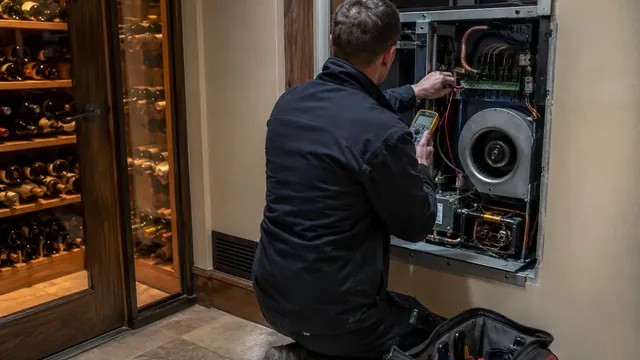
A cellar is a mechanical system and mechanical systems need looking at. Ann Arbor Wine Cellars services and repairs cellars across Washtenaw County whether or not we built them, covering cooling diagnostics and repair, condenser cleaning, refrigerant work under EPA Section 608 certification, gasket and drop seal replacement, sensor recalibration and condensate line clearing. Most of what we attend is preventable: a condenser coil choked with dust, a gasket that has lost compression, or a condensate pump that quietly stopped six months ago.
Wine Cellar Repair and Maintenance Ann Arbor MI
The most common emergency call we get is a cellar that has drifted warm, and the most common cause is a condenser that has not been cleaned since it was installed.
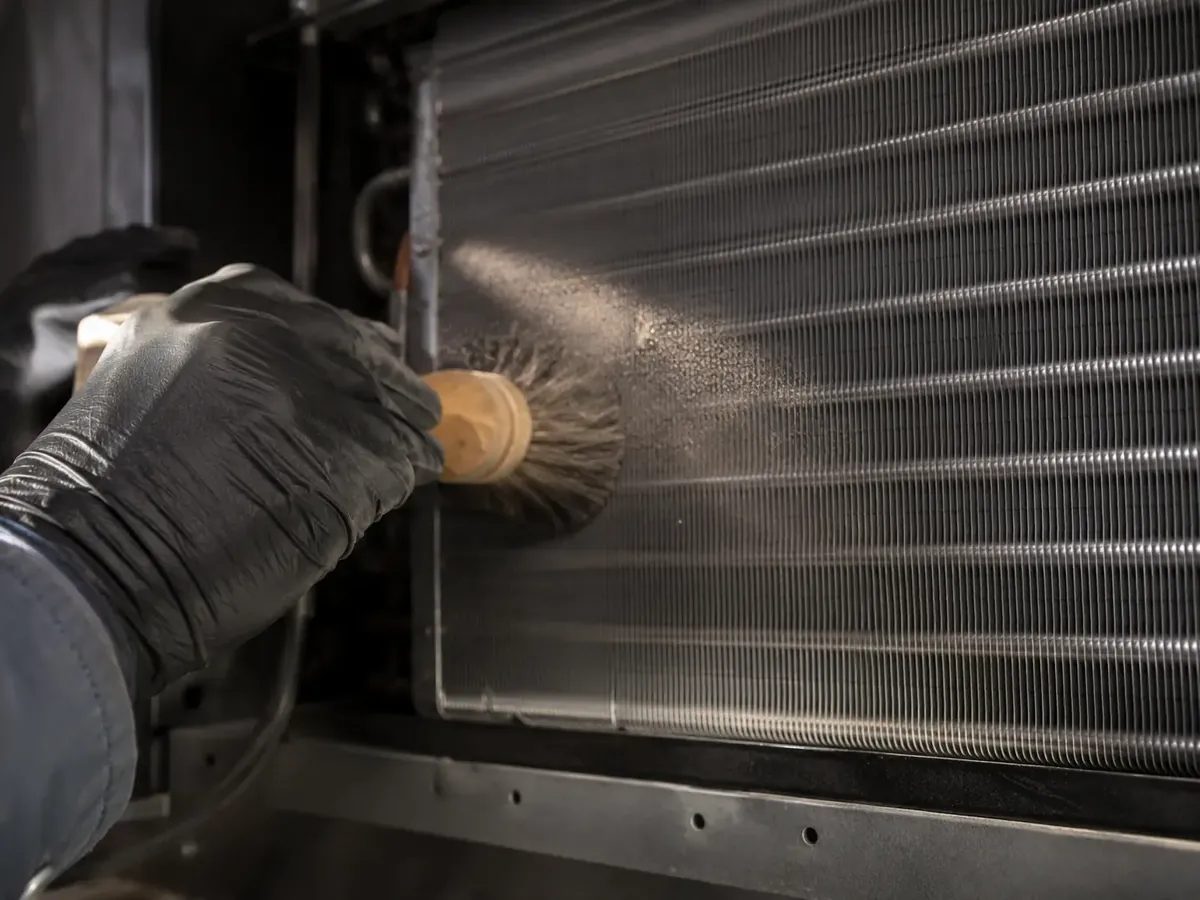
- Condenser coils cleaned and airflow path cleared
- Refrigerant charge checked by a certified technician
- Door gasket compression and drop seal travel checked and adjusted
- Condensate route tested, including any pump, rather than assumed working
A condenser rejects heat by moving air across a finned coil. As that coil loads with dust, the system loses capacity gradually rather than suddenly, so the cellar creeps warm over months and nobody notices until it is several degrees out. Cleaning takes twenty minutes and restores most of the lost performance.
The usual approach
A cellar left completely alone for a decade, discovered at 64 degrees one August because nobody ever looked at the coil or the condensate pump.
How we do it
An annual visit that cleans the coil, checks the charge, tests the condensate route and adjusts the door seals before any of them become a problem.
Service scope
- Cooling
- Diagnostics, repair, recharge
- Refrigerant
- EPA 608 certified handling
- Door
- Gasket and drop seal adjustment
- Interval
- Annual, or biannual on commercial
What actually matters in cellar maintenance
Cellar failures are almost never sudden. They are slow drifts that go unnoticed because there is nothing in the room that tells you something has changed.
- A dirty condenser coil reduces capacity progressively, so the cellar warms by fractions of a degree per week and the change stays below the threshold anyone would notice.
- Condensate pumps fail silently and the first symptom is usually water appearing somewhere unexpected rather than an alarm.
- Door gaskets lose compression gradually as they take a set, and a seal that is 80 percent effective leaks continuously without ever looking broken.
- Any refrigerant work legally requires EPA Section 608 certification, which is worth checking before anyone opens a sealed system in your house.
Routine annual servicing is priced as a flat visit and covers cleaning, checks and minor adjustment. Repairs are quoted after diagnosis, because the range between a failed capacitor and a failed compressor is enormous.
On units beyond roughly fifteen years old we will tell you honestly when repair stops making sense. Parts availability for older cellar-specific equipment gets difficult, and a repair that buys a year on a twenty year old unit is rarely good value.
Before a repair or service visit
A few minutes of preparation makes a service visit considerably more useful, particularly if something is actually wrong.
- Note what the cellar has been reading and for how long. Even rough figures from memory help, and a photograph of the display over a few days helps more.
- Clear access to the cooling equipment on both sides. Condensers are frequently boxed in behind stored items, and the visit gets shorter if we are not moving boxes first.
- Find the original equipment documentation if you have it. Model numbers determine parts availability, and on units over about fifteen years old that is the deciding factor in repair versus replace.
- Listen for when the unit runs and roughly how often. Continuous running, very short cycles and long silences all point at different faults, and you can hear the difference more easily than we can in a single visit.
Wondering whether to repair or replace?
Our cost guide covers the point at which replacing cellar equipment becomes better value than continuing to repair it.
How your wine cellar repair & maintenance project works
Understand the symptom
We ask what the cellar has been doing and for how long, because the pattern of the drift points at the cause faster than any single measurement.
Diagnose properly
Electrical, refrigerant, airflow, condensate and envelope are all checked rather than replacing the most likely part and hoping.
Repair or advise
We repair what is economic to repair and tell you plainly when a unit has reached the end of sensible service life.
Service and log
Coils are cleaned, seals adjusted, condensate tested and the cellar is left with a logged record of what was found and done.
Wine Cellar Repair & Maintenance questions we get asked
My cellar is running warm. What should I check first?
Look at the condenser coil. If it is furred with dust, that alone can account for several degrees of lost performance, and cleaning it is something you can do yourself with a soft brush and a vacuum.
After that, check the door seals by closing the door on a sheet of paper at several points around the frame. If the paper pulls out easily, the gasket has lost compression.
How often should a wine cellar be serviced?
Annually for a residential cellar, and twice a year for commercial rooms where door traffic and run hours are much higher.
The annual visit is mostly preventive. It is far cheaper than the emergency call that follows a summer of a slowly degrading coil.
Do I need to be present while you service my cellar?
Someone needs to let us in and, ideally, tell us what the room has been doing. Beyond that, no, a routine service takes an hour or two.
For a diagnostic visit on a fault, having whoever noticed the problem available is genuinely helpful.
Do you offer free quotes for wine cellar repair?
We quote repairs free once we have diagnosed the fault, but the diagnostic visit itself is charged, because it is the work. We tell you that cost upfront rather than at the end.
Call 734-415-4984 and we will explain what a visit involves before booking it.
Can you service a cellar built by someone else?
Yes, and a good portion of our maintenance work is on cellars we did not build. We do not require any history with the room.
We will tell you if we find something in the original build that will keep causing problems, but that is information rather than a sales pitch.
What should I do if the cooling fails in summer?
Keep the door shut. A well-insulated cellar holds temperature for a surprisingly long time if it is not opened, and every opening costs you hours of buffer.
Call us, and if the outage is likely to run for days, move the most valuable bottles to the coolest stable place you have rather than leaving everything to warm gradually.
What goes wrong, and what we do instead
Cellar failures are almost never sudden. They are slow drifts nothing in the room tells you about.
| The mistake | What it causes | What we do instead |
|---|---|---|
| Condenser coil never cleaned | Capacity lost by fractions weekly until the room is several degrees out | Annual coil cleaning and airflow check, which takes about twenty minutes |
| Condensate pump assumed working | Silent failure discovered when water appears somewhere unexpected | Test the full condensate route, pump included, at every visit |
| Door gasket left until it looks broken | A seal at 80 percent effectiveness leaking continuously | Check and adjust gasket compression and drop seal travel annually |
Catch the slow drift before it costs you bottles
Book an annual service and we will clean, check and log the whole system.