
Cellar types and styles
Wine Cellar Conversions in Ann Arbor, MI | Closets and Storage Rooms Converted
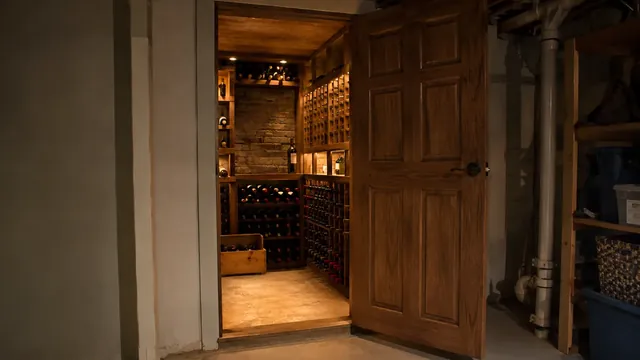
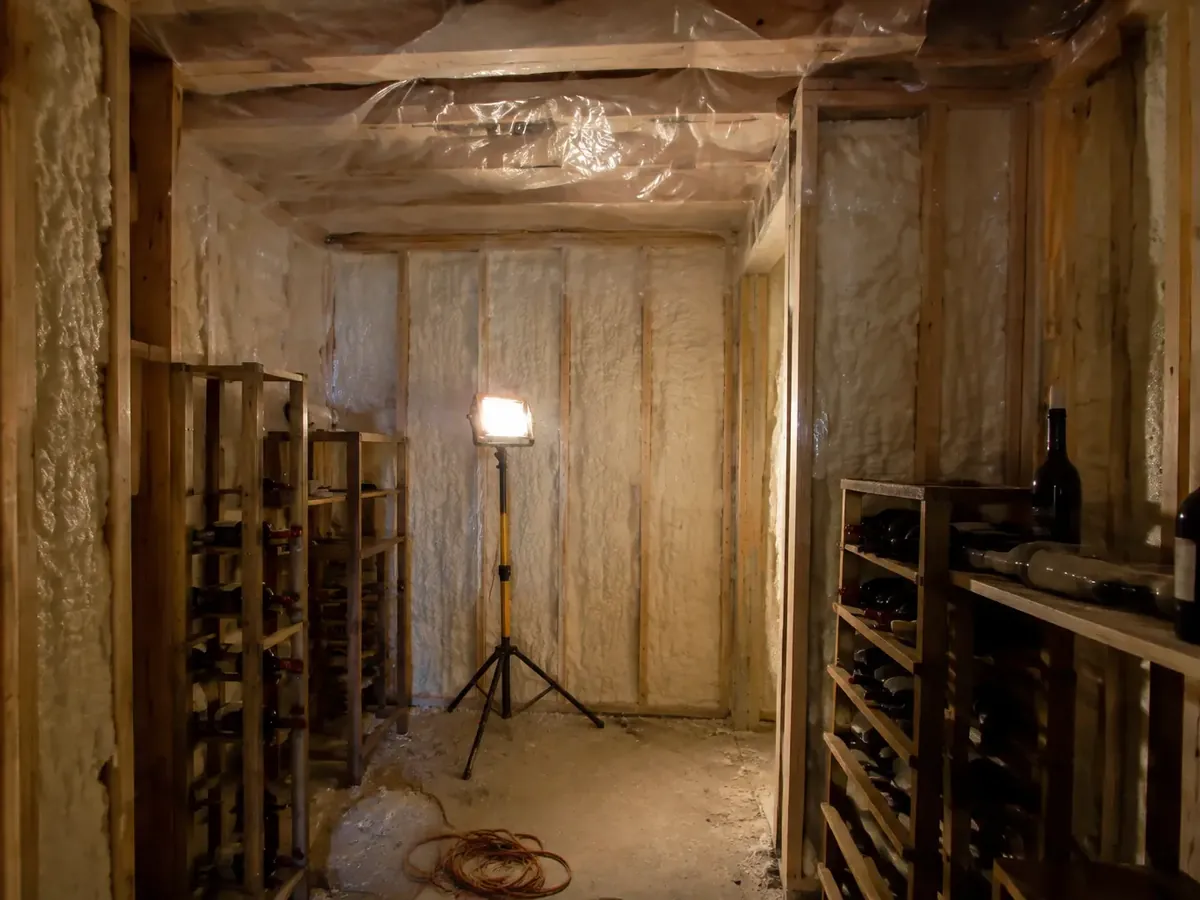
A conversion takes a room you already have and turns it into one that holds 55 degrees. Ann Arbor Wine Cellars converts basement closets, under-stair spaces, old coal rooms, storage rooms and spare corners into sealed cellars, typically in two to three weeks. The existing walls almost never do anything useful thermally, so the work is mostly building a new insulated box inside the old one: closed cell foam at R-6.5 to R-7 per inch, a continuous vapour plane, a dedicated 20 amp circuit and a door that actually seals.
Wine Cellar Conversions Ann Arbor MI
Conversions are the most common way people get their first real cellar, and they are usually the best value per bottle stored. What they are not is simple decoration of an existing room.
- A new insulated envelope built inside the existing room, not applied to it
- Existing hollow-core or louvred door replaced with a sealing unit
- Dedicated 20 amp AFCI and GFCI protected circuit run for the cooling
- Existing HVAC supply and return in the room closed off and sealed
The single most common oversight in a conversion is the heating duct. Almost every basement storage room in Ann Arbor has a supply register or an open return in it, and leaving either in place means your furnace and your cellar cooling fight each other all winter. Both get capped and sealed as part of the envelope work.
The usual approach
Insulation stapled between the existing studs, the old louvred door left in place, and a through-the-wall unit fitted to a room that is still connected to the house ductwork.
How we do it
A sealed box built inside the room, ducts capped, a gasketed door with a drop seal, and a circuit that belongs to the cellar alone.
Conversion specification
- Typical footprint
- Closet to small storage room
- Insulation
- Closed-cell foam, 2 in minimum
- Electrical
- Dedicated 120V 20A circuit
- HVAC
- Existing supply and return capped
What actually matters in a conversion
Conversions are judged on whether the finished room holds temperature economically, and that is decided almost entirely by things that get buried in the first week of work.
- An existing basement partition wall built of single studs and drywall carries essentially no insulation value, so the conversion has to add a full assembly rather than improve the existing one.
- Louvred and hollow-core doors are designed to allow air movement, which is the opposite of what a cellar needs. Replacing the door is not optional.
- Any open supply register or return grille left in the room ties the cellar to the whole house air system and makes stable temperature impossible.
- Small rooms have a high surface-area-to-volume ratio, so proportionally more of the cooling load is envelope loss than in a large cellar. Insulation quality matters more, not less, in a small conversion.
A conversion is generally the most economical route to a working cellar, because the structure, floor and ceiling already exist and the footprint is usually modest. The cost sits mostly in the envelope, the door and the cooling.
The variable that most often moves a conversion quote is electrical. If your panel has spare capacity and sits near the room, running a dedicated circuit is straightforward. If the panel is full or on the other side of the house, a subpanel or a long run adds meaningfully to the total.
Before we convert your room
Conversions move quickly once they start, so nearly all the useful preparation is about clearing the space and knowing what is inside the walls.
- Empty the room completely, including anything on high shelves. We are working on all six surfaces of the space and there is nowhere to push things aside to.
- Tell us about anything you know runs through those walls. Old Ann Arbor basements frequently have abandoned gas lines, disused chimney flues and buried junction boxes that need to be found and dealt with rather than foamed over.
- Check whether the room currently houses anything the house depends on, such as a water shutoff or a cleanout. Those need to remain accessible, which usually means relocating them before the envelope is sealed.
- Look at what the room shares a wall with. A conversion against the boiler or water heater room takes a large additional heat load and may need a thicker assembly on that one surface.
A conversion needs a dedicated circuit, and that has code implications.
Our permits and codes guide explains the NEC 2023 requirements for cellar circuits in Washtenaw County.
How your wine cellar conversions project works
Assess the existing room
We check the walls, look for hidden services, confirm what the room shares surfaces with, and locate the panel for the new circuit.
Strip and seal
Existing finishes come out, ductwork is capped, penetrations are sealed and the new insulated envelope is sprayed and vapour controlled.
Door and mechanical
The sealing door is hung, the dedicated circuit is run and terminated, and the cooling unit is fitted and charged.
Rack and hand over
Racking is installed to suit the converted footprint, then the room is run at temperature and checked for stability before you load it.
Wine Cellar Conversions questions we get asked
Is my closet big enough to convert?
A closet with an interior depth of about 28 inches or more can take single-sided racking and become a genuine cellar. Below that you are limited to case storage or shallow display.
Width matters less than depth. We have converted spaces as narrow as three feet into several hundred bottle cellars by using full-height racking on the back wall alone.
Can you convert a room that has a window?
Yes, though the window is a significant weak point and usually gets either insulated over or replaced with a sealed insulated unit. Basement windows in older Ann Arbor houses are frequently single glazed steel, which will condense heavily at cellar temperatures.
If you want to keep daylight, we treat it exactly like a glass enclosure and specify the glazing accordingly.
Do I need to be present while you convert my room?
No. Conversions are contained to a single room and we work behind dust protection, so the rest of the house stays usable.
We will need brief access to your electrical panel on the day the dedicated circuit is run.
Do you offer free quotes for wine cellar conversions?
Yes. Conversions are the easiest projects to quote accurately from a single visit, because the room already exists and we can measure everything on the spot.
Call 734-415-4984 and we will come and look at the space.
Will converting a closet reduce my home's storage?
Yes, and that is worth thinking about honestly before you start. A converted closet is no longer a closet, and the envelope work makes it impractical to convert back cheaply.
Most clients choose an under-stair space, an old coal room or an unused basement corner precisely to avoid giving up storage the household actually uses.
Can a converted cellar be expanded later?
It can, but expanding means breaching the sealed envelope and vapour plane you just paid for, then re-establishing both around the new footprint.
If you think expansion is likely, it is far cheaper to build the larger envelope now and simply rack half of it, leaving the rest for later.
What goes wrong, and what we do instead
Conversions are judged on whether the room holds temperature economically, and that is decided in the first week of work.
| The mistake | What it causes | What we do instead |
|---|---|---|
| Existing supply register left in the room | The furnace and the cellar cooling fighting each other all winter | Cap and seal every duct and return before the envelope is closed |
| Original louvred or hollow-core door kept | Continuous air exchange with the rest of the basement | Replace with a 1 3/4 inch sealing door, gasket and drop seal |
| Insulation stapled between existing single studs | An assembly with almost no real insulation value | Build a new insulated box inside the room rather than upgrading the old one |
Turn the room you are not using into the one you will
Send us a photo of the space and we will tell you honestly whether it is a good candidate.