
Specialty and materials
Cable Wine Wall Systems in Ann Arbor, MI | Bottles That Appear to Float
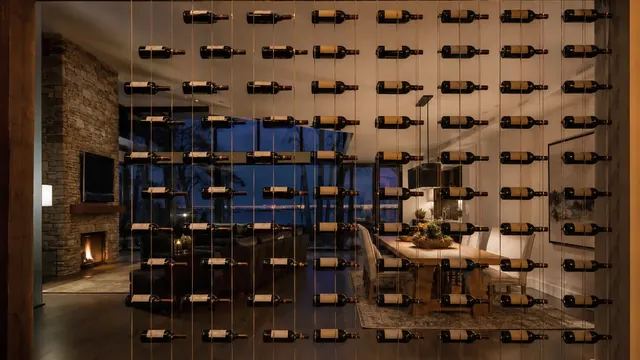
A cable wall is the least visually present way to store wine that exists. Ann Arbor Wine Cellars installs tensioned 316 marine-grade stainless steel cable systems with aircraft-aluminium hubs, running floor to ceiling, holding bottles horizontally and label-forward with almost nothing visible supporting them. They work as room dividers as well as storage, which is why they turn up most often in open-plan spaces rather than closed cellars. The engineering constraint is tension: the cables pull hard at both ends and the structure at floor and ceiling has to take it.
Cable Wine Wall Systems Ann Arbor MI
Cable systems are structural before they are decorative. Each run is tensioned between an anchor in the floor and one in the ceiling, and those anchors have to reach something solid.
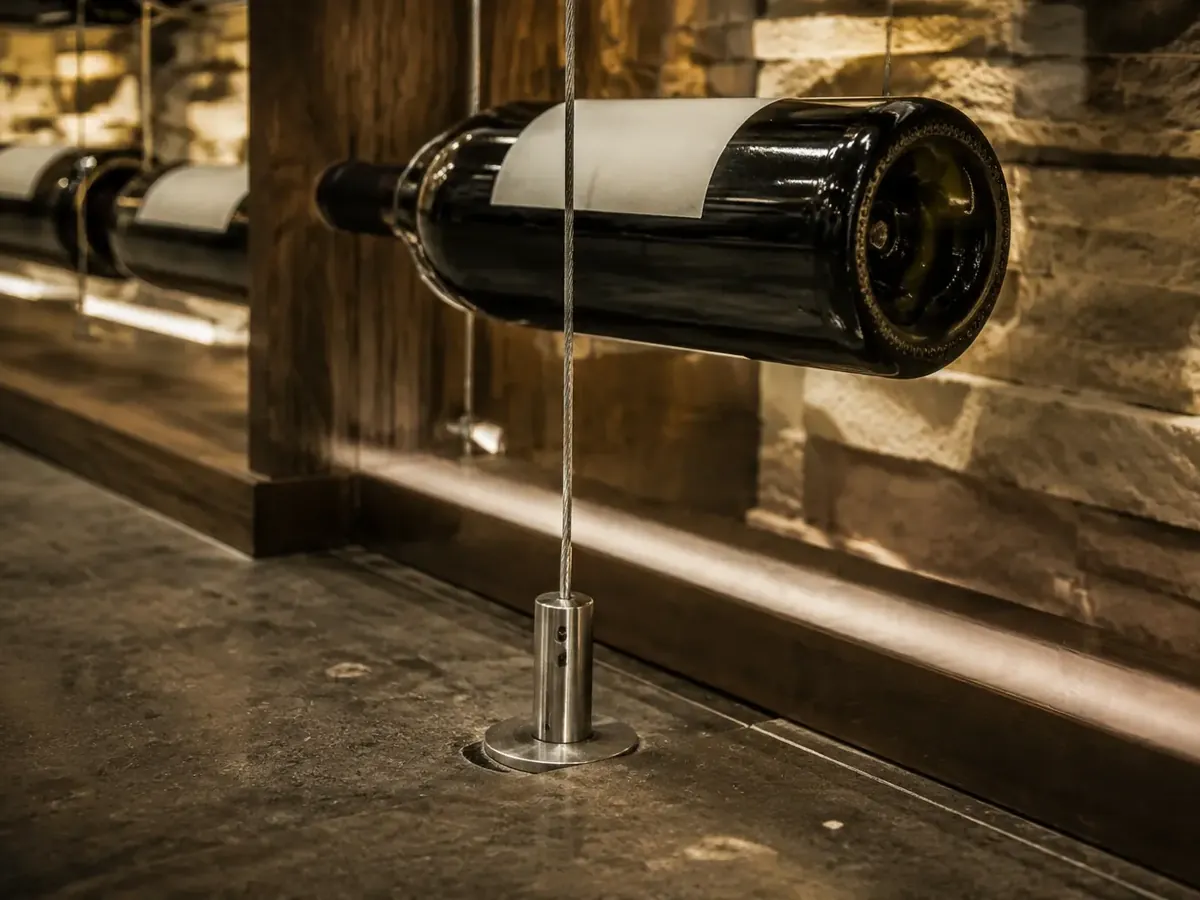
- 316 marine-grade stainless cable, corrosion stable at cellar humidity
- Anchor points reaching structure at both floor and ceiling
- Tension set to specification and rechecked after initial loading
- Bottles held horizontal, label forward, on machined aluminium hubs
The reason we specify 316 rather than a cheaper stainless grade is that 316 contains molybdenum and resists pitting corrosion in humid conditions far better. A cellar at 60 percent relative humidity for decades is a genuinely demanding environment for a load-bearing cable, and pitting on a tensioned cable is a structural issue rather than a cosmetic one.
The usual approach
A cable system anchored into a suspended ceiling and a floating floor, losing tension within months and sagging visibly across the run.
How we do it
Anchors reaching real structure at both ends, tensioned to specification, and rechecked once the wall is fully loaded.
Cable system specification
- Cable
- 316 marine-grade stainless
- Hubs
- Machined aircraft aluminium
- Anchoring
- Structure at floor and ceiling
- Tension
- Set, then rechecked loaded
What actually matters in a cable wall
Everything about a cable wall depends on two things you cannot see once it is finished: what the anchors reach and how the tension was set.
- Anchors must reach structural slab, joist or beam. A cable tensioned into a suspended ceiling grid or a floating floor will pull free or sag, and neither failure is graceful.
- Cable stretches slightly under initial load, so tension has to be rechecked after the wall is first filled rather than only at installation.
- 316 stainless resists pitting corrosion in humid environments in a way that lower grades do not, which matters for a component under permanent tension.
- A cable wall provides no visual screening at all, so it divides space without dividing sightlines, which is either exactly what you want or entirely wrong for the room.
Cable systems are priced per run plus per bottle position, and they generally sit at the upper end of racking costs because the components are machined and the installation is precise work.
Where structural blocking or backing has to be added at floor or ceiling, that is additional work best done during construction. Retrofitting anchors into a finished space is possible but involves opening up both the ceiling and the floor.
Before we install a cable wall
Cable systems need structural certainty at both ends, and that is worth establishing before anything is ordered.
- Confirm what the ceiling actually is above the finish. A cable wall cannot be anchored into drywall or a dropped ceiling, and finding that out on installation day is the worst time.
- Check the floor construction at the anchor line. A slab is straightforward. A timber floor needs the anchor to land on a joist or on added blocking installed from below.
- Decide the run spacing before ordering. Cable spacing determines bottle capacity and it cannot be adjusted afterwards without new floor and ceiling anchors.
- Think about what is behind the wall visually. A cable system shows whatever is behind it, so the surface beyond the bottles becomes part of the design whether you intended it or not.
Cable walls are usually part of a contemporary scheme.
Our cost guide covers where fabricated systems sit relative to timber racking in a cellar budget.
How your wine cellar cable wine wall systems project works
Verify the structure
We confirm what the anchors will reach at both floor and ceiling before any cable wall components are ordered.
Prepare anchor points
Blocking or backing is added where needed so every anchor lands on genuine structure rather than finish.
Set and tension
Cable runs are installed and tensioned to specification, with hubs positioned for your bottle diameters.
Load and recheck
The cable wall is loaded and the tension is rechecked and reset, since cable takes an initial stretch under load.
Wine Cellar Cable Wine Wall Systems questions we get asked
How much weight can a cable wall hold?
A properly anchored system holds a full complement of bottles without difficulty, but the capacity is set by the anchors and the structure rather than the cable itself.
The cable is rarely the limiting factor. What limits a cable wall is what the floor and ceiling can take.
Do cable walls sag over time?
They take a small initial stretch when first loaded, which is why we return and reset the tension after the wall is filled. After that, a correctly specified system stays put.
Ongoing sag indicates either an anchor moving or under-specified cable, and both are worth addressing immediately.
Do I need to be present while you install a cable wall?
Not for the installation, but we do come back to recheck tension once the wall is loaded, and it is helpful if you can tell us when it is full.
That return visit is part of the job rather than an extra.
Do you offer free quotes for cable wine wall systems?
Yes, though the quote depends on confirming the structure at floor and ceiling, so the survey matters more here than for most racking types.
Call 734-415-4984 to arrange a visit.
Can a cable wall be used as a room divider?
Yes, and that is one of its best applications. It defines a boundary without blocking light or sightlines, which suits open-plan spaces where a solid wall would feel heavy.
Bear in mind it provides no acoustic separation and no thermal separation at all, so the wine is at room temperature unless the whole space is conditioned.
How often does the tension need checking?
Annually is plenty once the initial stretch has been taken up. It takes a few minutes and we include it in a maintenance visit.
If you notice a run looking slack between visits, it is worth a call rather than waiting, since a loose cable puts uneven load on the remaining ones.
Can a cable wall be extended or reconfigured later?
Adding runs alongside existing ones is straightforward provided the floor and ceiling structure continues far enough to take new anchors, which is worth checking before the first installation.
Repositioning existing runs is harder, because it means new anchor points at both floor and ceiling and making good the old ones in what is usually a polished concrete floor.
What goes wrong, and what we do instead
Everything about a cable wall depends on two things you cannot see once it is finished.
| The mistake | What it causes | What we do instead |
|---|---|---|
| Anchors fixed into a dropped ceiling or floating floor | Tension pulling free, or a run sagging visibly within months | Anchors reaching structural slab, joist or beam at both ends |
| Tension set once at installation | Visible sag after the cable takes its initial stretch under load | Return and reset tension once the wall is fully loaded |
| Lower-grade stainless used | Pitting corrosion on a component under permanent tension | 316 marine-grade cable with machined aluminium hubs |
Bottles that appear to float
We will verify the structure at both ends before we quote, because that is what the whole system depends on.