Core services
Wine Cellar Lighting Design in Ann Arbor, MI | Warm Light, No Heat and No UV
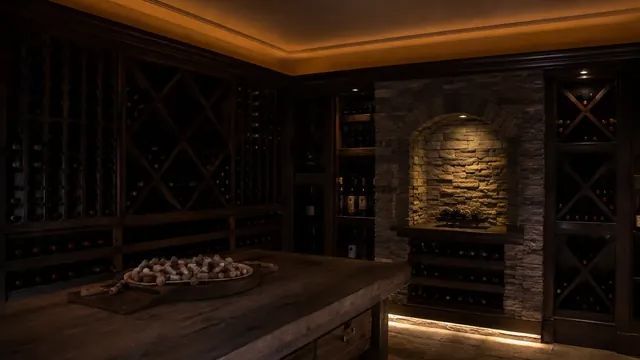
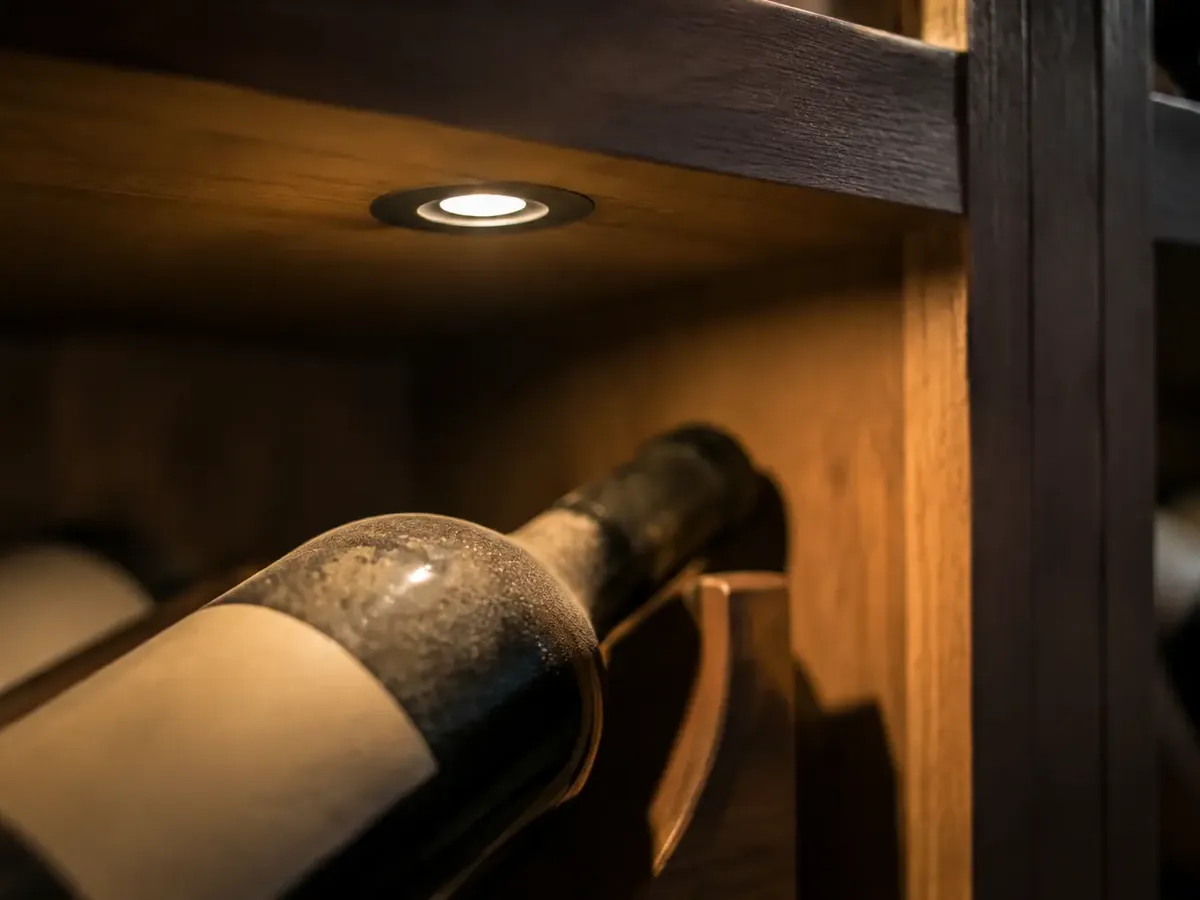
Lighting is the difference between a cellar that photographs well and one that feels like a utility room with wine in it. Ann Arbor Wine Cellars designs cellar lighting in layers: sealed micro-cove runs washing the ceiling perimeter, low grazing light at the toe kick, and focused display light in niches and on feature bottles. Every fitting is LED at 2700K or lower, emitting zero ultraviolet, and every magnetic low-voltage transformer sits outside the thermal envelope so its waste heat never enters the room the cooling system is working on.
Wine Cellar Lighting Design Ann Arbor MI
Two constraints shape every cellar lighting decision: light must not heat the room, and it must not carry ultraviolet. Everything else is aesthetics.
- LED only, at 2700K or lower, for a warm reading on glass and timber
- Zero UV output, since ultraviolet degrades wine through the bottle
- Transformers and drivers mounted outside the conditioned envelope
- IP65 damp-location fittings wherever humidity reaches the fixture
Halogen and incandescent lighting are both disqualified in a cellar, not because they look wrong but because they dump heat directly into a room you are paying to keep at 55 degrees. A handful of 50 watt halogen downlights represents a meaningful continuous load on a small cellar's cooling system, and they run hot enough to warm the bottles directly beneath them.
The usual approach
Domestic downlights on a single switch, drivers tucked into the ceiling void inside the cellar, throwing heat into the room and making the wine look grey.
How we do it
Three separate lit layers at 2700K, drivers outside the envelope, with the cellar dimmable from browsing level down to a low display glow.
Lighting specification
- Source
- LED only
- Colour temperature
- 2700K or lower
- UV output
- Zero
- Driver location
- Outside thermal envelope
What actually matters in cellar lighting
Cellar lighting has one aesthetic job and two technical ones, and the technical ones are non-negotiable because they affect the wine rather than the photograph.
- Ultraviolet passes through clear and green glass and degrades wine over time, which is why UV-free output is a specification rather than a preference.
- Every watt consumed inside the cellar becomes heat inside the cellar, so the internal gain from lighting belongs in the cooling calculation rather than being ignored.
- Colour temperature above about 3000K makes red wine read brown and timber read grey, which is why warm white is the standard rather than a stylistic choice.
- Fittings in a 60 percent humidity environment need a damp-location rating, since standard dry-rated recessed cans corrode at the terminals over a few years.
Lighting is a larger share of a cellar budget than most people expect, frequently approaching the cost of mid-range racking, because architectural fittings and remote driver locations both add cost over domestic equivalents.
The single most cost-effective element is cove lighting. A continuous warm wash along the ceiling perimeter transforms how a cellar reads for a fraction of what individually aimed display fittings cost.
Before we design your cellar lighting
Lighting has to be planned before the walls close, because almost nothing about it can be changed afterwards without opening the envelope.
- Decide which bottles or features deserve their own light. Display lighting is aimed at specific positions, and adding an aimed fitting later means cutting into a sealed ceiling.
- Choose where the switches and dimmers go, and whether you want them inside or outside the cellar. Outside is usually better, since it avoids a penetration and lets you light the room before entering it.
- Find a location outside the cellar for the drivers and transformers that is accessible for service. Drivers fail before LEDs do, and one buried behind finished drywall is a genuine problem.
- Think about whether you want the cellar visible when unoccupied. A low standing display level, separately switched, is what makes a glass-fronted cellar work at night.
Lighting is an internal heat gain, and it counts.
Our cooling sizing guide explains how internal gains from lighting enter the heat load calculation.
How your wine cellar lighting design project works
Plan the layers
We establish what needs to be lit for browsing, what needs display light, and what the room should look like when nobody is in it.
Locate drivers
Driver and transformer positions are fixed outside the thermal envelope, in a location that stays accessible after the build.
Rough in early
All lighting cable is pulled before insulation, because a sealed envelope cannot be opened for an extra circuit afterwards.
Aim and dim
Once racking is loaded we aim the display fittings and set the dimming levels for each layer, because lighting can only be judged against a full cellar.
Wine Cellar Lighting Design questions we get asked
Can I use LED strip lighting from a hardware store?
The LEDs themselves are usually fine. The problems are the driver, which will sit inside the cellar unless you plan otherwise, and the colour temperature, which is often 4000K or higher and makes wine look wrong.
The other issue is damp rating. Unrated strip in a 60 percent humidity room tends to fail at the solder joints within a few years.
Does light damage wine through the bottle?
Ultraviolet does, and green glass only filters part of it. Dark bottles offer more protection than clear ones, which is why so many wines are bottled in dark glass in the first place.
LED at 2700K with no UV output removes the risk entirely, which is why it is the only source we specify.
Do I need to be present while you install cellar lighting?
For the final aiming session, yes, and it is worth it. Where display light lands is a matter of taste and takes ten minutes to agree in the room.
The rough-in and installation do not need you there.
Do you offer free quotes for wine cellar lighting design?
Yes, and lighting is usually quoted as part of a wider cellar project. We can also design and install lighting into an existing cellar, though that is constrained by what can be reached without breaching the envelope.
Call 734-415-4984 to discuss.
Should the lights be on a timer or a motion sensor?
Motion sensors work well for the browsing layer, since they keep the light off when nobody is there and remove the possibility of leaving it on.
We usually keep display lighting on a separate dimmer rather than a sensor, because the point of it is to be visible when you are not in the room.
How bright should a cellar be?
Dimmer than you think for display, brighter than you think for finding a specific bottle. Those two needs conflict, which is exactly why we build separate switched layers rather than one level.
A browsing layer around 150 to 200 lux at the rack face is comfortable, with display layers well below that.
What goes wrong, and what we do instead
Lighting has one aesthetic job and two technical ones, and the technical ones affect the wine.
| The mistake | What it causes | What we do instead |
|---|---|---|
| Halogen or incandescent fittings | Direct heat into a room you are paying to hold at 55 degrees | LED only, at 2700K or lower, with zero UV output |
| Drivers tucked into the cellar ceiling void | Internal heat gain the cooling has to remove continuously | Drivers and transformers mounted outside the thermal envelope |
| Dry-rated fittings in a 60 percent humidity room | Corrosion at the terminals within a few years | IP65 damp-location fittings wherever humidity reaches the fixture |
Light that flatters the wine and does not warm it
We will plan the layers, keep the drivers outside, and aim everything once the racking is full.