Specialty and materials
Wine Cellar Security System Installation in Ann Arbor, MI | Access Control and Condition Logging
Once a collection reaches a certain value it stops being furniture and starts being an insured asset, and insurers ask specific questions. Ann Arbor Wine Cellars installs cellar security to answer them: keypad or credential access control on a commercial mortise lock, entry logging so you know who opened the room and when, discreet camera coverage of the entry rather than the whole room, and environmental monitoring that records conditions continuously. That last one matters more than people expect, because a climate failure claim usually depends on being able to show what the room was actually doing.
Wine Cellar Security System Installation Ann Arbor MI
Security for a cellar is less about forced entry than most people assume. The realistic risks are casual access, a climate failure nobody documented, and an insurance claim you cannot substantiate.
- Access control on a commercial mortise lock, not a domestic latch
- Entry events logged with time and credential
- Camera coverage at the entry, positioned for identification rather than surveillance
- Environmental conditions recorded continuously and retained
Environmental logging is the part that quietly earns its cost. If a cooling failure compromises a collection, the claim turns on demonstrating what happened and when. A cellar with a continuous record of temperature and humidity gives you that. A cellar with a thermostat and no history gives you an argument.
The usual approach
A domestic latch on a hollow-core door, no record of who has been in the room, and no data at all about what the conditions were doing before the bottles were found spoiled.
How we do it
Credentialed access with a log, a camera on the entry, and a continuous environmental record you can hand to an adjuster.
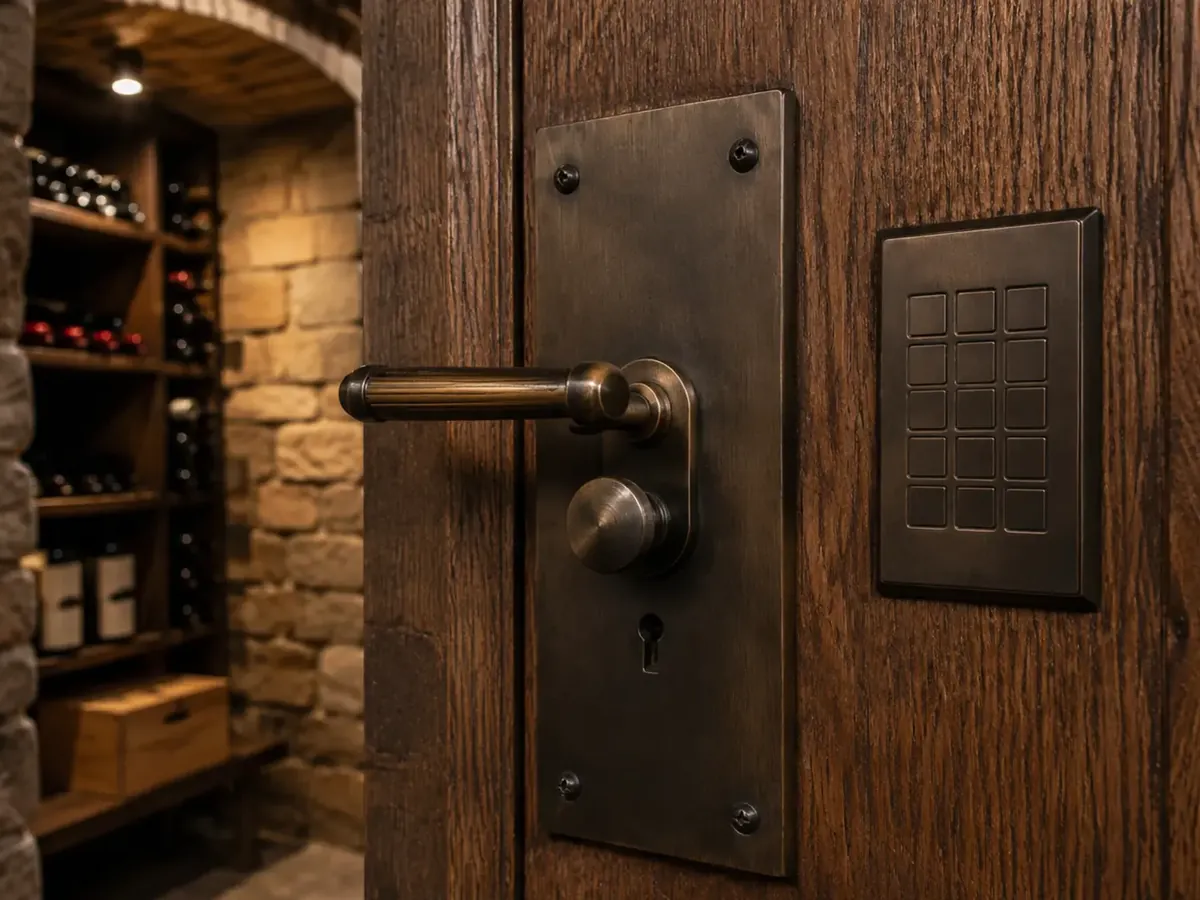
Security specification
- Lock
- Commercial mortise
- Access
- Keypad or credential, logged
- Camera
- Entry coverage, identification framing
- Records
- Environmental, continuously retained
What actually matters in cellar security
Cellar security is mostly about evidence and access rather than resistance, because a determined intruder in your house has already passed every other layer.
- Access logging changes behaviour more than locks do, particularly in households with staff, contractors or guests, and it costs very little to implement.
- Insurers typically ask about access control and environmental monitoring rather than about intrusion detection, so specifying to their questions is more useful than specifying to a general security standard.
- Cameras inside the cellar itself are rarely useful and raise privacy questions with anyone working in the house. Coverage of the entry is what actually identifies who came and went.
- Any device installed inside the cellar has to tolerate 60 percent humidity permanently, which rules out a good deal of standard consumer security hardware.
Cellar security is layered and priced accordingly. Environmental logging is inexpensive and delivers the most practical value. Credentialed access control is a moderate cost. Camera coverage and integration with a wider house system sit above that.
Where a cellar door is being replaced anyway, adding a commercial mortise lock and keypad at that point costs far less than retrofitting them into an existing door later.
Before we install cellar security
Security work is best scoped against what your insurer actually requires rather than against a general idea of being secure.
- Ask your insurer what they specifically require for a collection of your value. The answer varies considerably between carriers and it determines the specification rather than the other way round.
- Decide who needs access and at what level. Access control is only useful if the credential list reflects reality, and households frequently have more people needing entry than expected.
- Establish where the recording and network equipment will live. It needs power, a network connection and somewhere outside the cellar humidity, and finding that late constrains the design.
- Have a current inventory and valuation. Security systems protect an asset, and neither an insurer nor an adjuster can act on a collection nobody has documented.
Environmental monitoring overlaps with backup cooling.
Our cost guide covers where monitoring sits relative to other protective spending on a cellar.
How your wine cellar security system installation project works
Ask the insurer first
We start from what your carrier actually requires for a collection of your value, since that determines the specification.
Specify to conditions
Every device inside the cellar is selected to tolerate permanent 60 percent humidity, and controllers are sited outside it.
Install and log
Access control, entry camera and environmental logging are installed and configured, with retention set appropriately.
Document and test
We test each element, confirm the log is recording, and leave you with documentation in the form an insurer will ask for.
Wine Cellar Security System Installation questions we get asked
Does my insurer require a security system for my wine?
It depends entirely on the carrier and the declared value. Many will insure a collection under a general contents policy up to a threshold and require specific measures above it.
The requirements we see most often are access control and documented environmental conditions rather than intrusion alarms.
Will a keypad survive cellar humidity?
A commercial-rated one will. Consumer smart locks frequently will not, since 60 percent relative humidity permanently is outside what much of that hardware is designed for.
We specify commercial hardware and mount the electronics on the warm side of the door wherever the design allows.
Do I need to be present while you install cellar security?
For credential setup, yes, since you will want to configure who has access rather than have us do it.
The physical installation does not require you and typically takes a day.
Do you offer free quotes for wine cellar security installation?
Yes. It helps enormously if you can tell us your insurer's requirements first, since quoting against a real specification is far more useful than quoting against a guess.
Call 734-415-4984 to discuss.
Should I put a camera inside the cellar?
Usually not. Coverage of the entry tells you who came and went, which is the useful information, and a camera inside the room raises reasonable privacy concerns with anyone working in the house.
The exception is a commercial cellar, where inventory control frequently justifies internal coverage.
Can security be integrated with my existing house system?
In most cases yes, and it is usually the better route since you get one app and one set of credentials rather than a separate system nobody checks.
We coordinate with your existing installer rather than replacing what works.
Can I monitor my cellar while I am away?
Yes, and for anyone who travels it is the single most useful thing you can install. A monitored sensor reports temperature and humidity continuously and sends an alert to your phone when either crosses a threshold you set.
That matters more than intrusion detection for most collections, because the realistic risk to wine in a locked house is a cooling failure nobody notices for a fortnight rather than a break-in.
What goes wrong, and what we do instead
Cellar security is mostly about evidence and access rather than resistance.
| The mistake | What it causes | What we do instead |
|---|---|---|
| Consumer smart lock fitted | Hardware failing in a permanent 60 percent humidity environment | Commercial mortise hardware, with electronics on the warm side |
| No environmental record kept | A climate failure claim that rests on argument rather than data | Continuous temperature and humidity logging, retained |
| Camera pointed into the cellar | Little useful information and reasonable privacy objections from staff | Coverage at the entry, framed for identification |
Protect the asset and document the conditions
Tell us what your insurer asks for and we will specify to it exactly.