
Cellar types and styles
Climate-Controlled Wine Storage Rooms in Ann Arbor, MI | Capacity and a Number That Holds
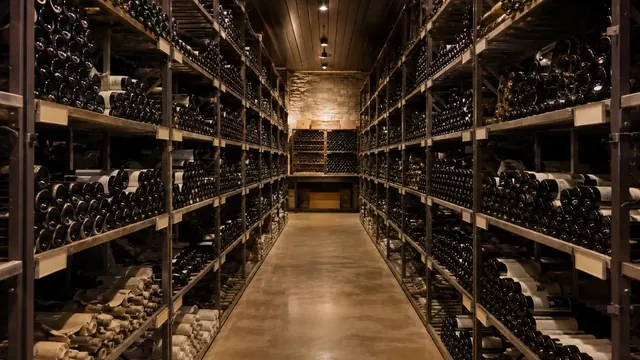
Some collections do not need a showpiece, they need capacity and a number that does not move. Ann Arbor Wine Cellars builds climate-controlled storage rooms to a straightforward brief: hold 55 degrees with no more than 1.5 degrees of drift per day, hold 60 percent relative humidity within a 55 to 70 percent band, and fit as many bottles into the footprint as the structure will safely carry. These rooms use uniform racking, plain durable finishes and instrumentation you can actually read, and they cost considerably less per bottle than a display cellar.
Climate-Controlled Wine Storage Rooms Ann Arbor MI
Stability is the entire point. Wine tolerates being held at a slightly wrong temperature far better than it tolerates being cycled up and down, because repeated expansion and contraction works against the cork seal.
- Temperature drift held within 1.5 degrees per day, not just an average
- Humidity kept inside the 55 to 70 percent band year round
- Uniform racking sized for maximum safe capacity
- Readable instrumentation rather than a hidden thermostat
Above 70 degrees, reaction rates in wine accelerate and volatile aromatic compounds are lost. Below 45 degrees, tartrate crystals precipitate out of suspension and structural development slows. The band between those is wide, but the daily swing inside it is what actually damages wine over years, which is why we specify a drift limit rather than just a set point.
The usual approach
A basement room with a domestic thermostat and a unit that swings four or five degrees between cycles, averaging 55 and never actually sitting there.
How we do it
A system with a tight dead band and enough thermal mass in the envelope that the room holds within 1.5 degrees across a full day.
Storage room specification
- Set point
- 55°F (12.7°C)
- Daily drift limit
- 1.5°F
- Humidity band
- 55-70% RH, 60% target
- Upper damage threshold
- 70°F
What actually matters in a storage room
Storage rooms are the easiest cellars to build well and the easiest to build badly, because there is no visual quality to hide behind. The room either holds its number or it does not.
- Averaging is not stability. A room cycling between 52 and 58 degrees averages 55 and is still working the corks twice a day, which is why a drift limit belongs in the specification.
- Thermal mass smooths cycling. Stone, masonry and even the bottles themselves buffer short swings, which is one reason a densely loaded room is more stable than a nearly empty one.
- Humidity below 50 percent dries natural cork, causing it to shrink, break the neck seal and raise the oxygen transmission rate into the bottle.
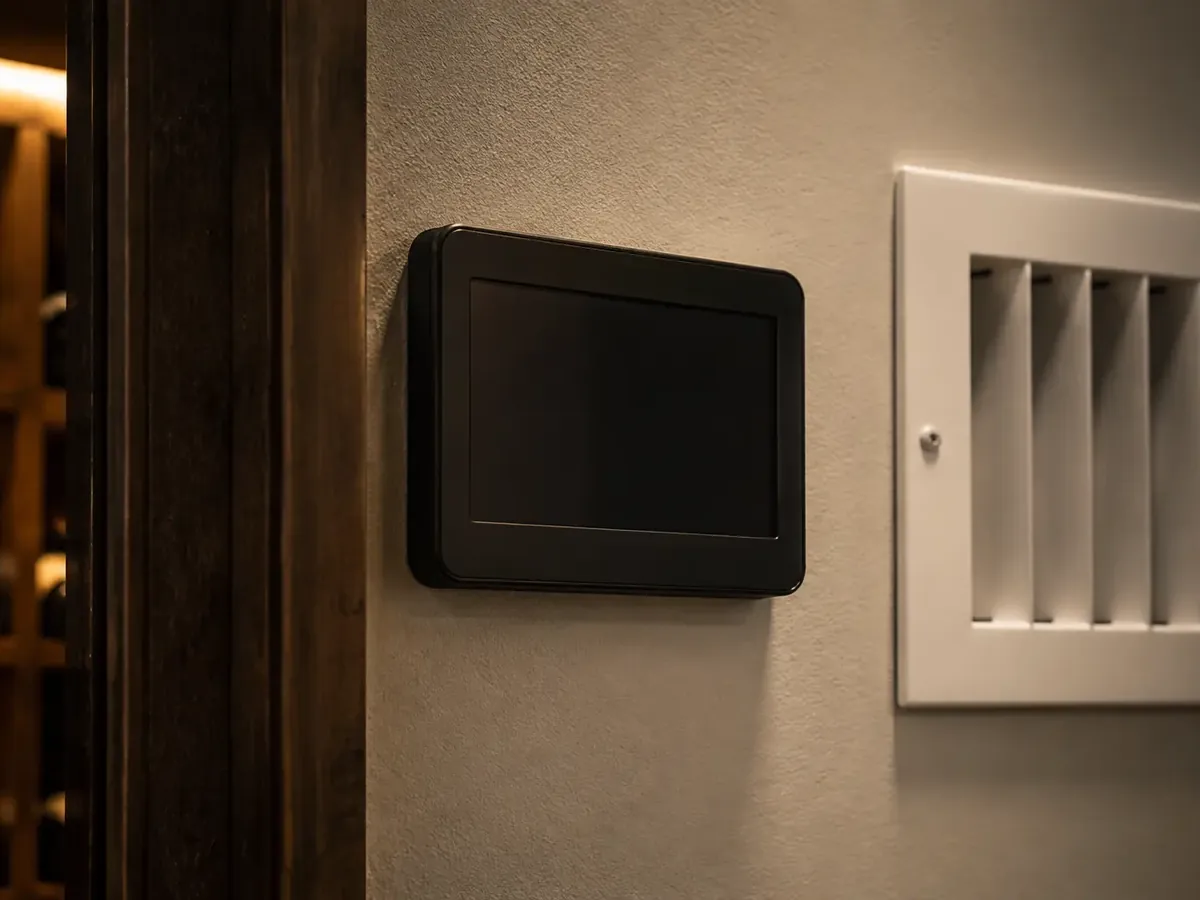
- Instrumentation you cannot see does not get checked. A readable display at the door is worth more in practice than a more accurate sensor buried behind racking.
Storage rooms are the best value per bottle of anything we build, because the money goes into envelope and mechanical rather than into millwork and finishes. Uniform metal or plain timber racking costs a fraction of figured hardwood.
The cost driver here is capacity and the structural work it may require. Reaching 100 to 150 pounds per square foot of floor loading is trivial on a slab and can be a real expense on a framed floor that needs reinforcement first.
Before we build your storage room
Storage rooms are about capacity, so the useful preparation is mostly about being realistic on volume and honest about structure.
- Count your current collection properly rather than estimating. Storage rooms are sized to a number and being 20 percent out changes the racking layout significantly.
- Tell us your acquisition rate. A collection growing by 200 bottles a year needs a very different capacity plan from a static one, and it is far cheaper to build the shelving in now.
- Find out what your floor is. A concrete slab on grade will carry almost any density we can build, but a wood-framed floor over a crawl space needs a structural check before we design to full capacity.
- Decide whether you need case storage. Rooms designed only for individual bottles handle unopened cases badly, and most serious collectors buy at least some wine by the case.
The numbers behind these targets are worth understanding.
Our cooling sizing guide explains where the 55 degree and 60 percent figures come from and how we hit them in a Michigan climate.
How your climate-controlled wine storage rooms project works
Establish real capacity
We count the collection, add your acquisition rate, and check what the floor can carry before designing the storage room layout.
Envelope and instrumentation
The room is sealed and insulated, and sensors are positioned where they represent the room rather than where the wiring was easiest.
Racking install
Uniform racking is installed to the calculated capacity, with case storage integrated where your buying pattern requires it.
Stability logging
The climate-controlled storage room is logged over several days and we adjust the dead band until daily drift sits inside the 1.5 degree limit.
Climate-Controlled Wine Storage Rooms questions we get asked
Is 55 degrees exactly right, or is there a range?
There is a workable range, roughly 53 to 59 degrees, and wine stored anywhere in it will age well. The number matters less than the stability around it.
We target 55 because it sits comfortably in the middle of that range, giving room for a small drift in either direction without approaching either damage threshold.
What happens if humidity goes too high?
Above about 75 percent you start getting label degradation and, on porous surfaces like exposed wood or masonry, the conditions for mould growth including Penicillium species.
The wine itself is usually unharmed, but labels and cases suffer, and mould in a sealed room is difficult to remove once established.
Do I need to be present while you build my storage room?
No. Storage rooms involve the least decision-making of anything we build, since the specification is largely numerical rather than aesthetic.
We will confirm racking layout with you once, and after that the build runs without you.
Do you offer free quotes for climate-controlled storage rooms?
Yes, and these are usually the quickest quotes we produce because the brief is well defined. Give us a bottle count and a room and we can be accurate quickly.
Call 734-415-4984 with your numbers.
Can I store other things in the room?
Spirits, beer and cigars all tolerate cellar conditions, though cigars want higher humidity than wine does and are better in a separate humidor.
Anything that outgasses, including solvents, cleaning products and freshly finished furniture, should stay out. Wine takes on aromas through the cork over time.
How full should the room be?
Fuller is more stable, because the bottles themselves provide thermal mass that smooths out short cycles. A room at 20 percent capacity will cycle more visibly than the same room at 80 percent.
That is not a reason to overbuy, but it is a reason not to build dramatically more capacity than you will realistically use.
What goes wrong, and what we do instead
Storage rooms have no visual quality to hide behind. The room either holds its number or it does not.
| The mistake | What it causes | What we do instead |
|---|---|---|
| Averaging 55 degrees rather than holding it | Corks worked twice a day by a four or five degree swing between cycles | A tight dead band and a specified drift limit of 1.5 degrees per day |
| Sensor mounted near the supply grille | A reading of the air the unit just produced, not the air the wine sits in | Sensor positioned to represent the room, at bottle height, away from supply |
| Humidity left to whatever the cooling does | Cork drying below 50 percent through the heating season | Humidity held inside the 55 to 70 percent band year round |
Capacity and a number that holds
Give us your bottle count and your room, and we will show you what it can hold and how tightly.