Specialty and materials
Custom Wood Wine Racking in Ann Arbor, MI | Redwood, Cedar, White Oak and Mahogany
Timber in a cellar has to survive 60 percent relative humidity forever without warping, rotting or giving off anything the wine can absorb. Ann Arbor Wine Cellars builds racking in four species chosen for exactly that: all-heart redwood, which resists rot and mildew naturally and is left unfinished to prevent solvent outgassing; premium clear western red cedar, dimensionally stable in humidity with natural aromatic tannins that deter insects without tainting corks; and white oak or Malaysian mahogany where a stained hardwood look is wanted. Any stain we use is a water-based zero-VOC architectural coating, fully cured before wine goes anywhere near it.
Custom Wood Wine Racking Ann Arbor MI
Wine takes on aroma through the cork over years. Anything in the room that outgasses will eventually be in the bottle, which is why species selection and finish selection are technical decisions rather than aesthetic ones.
- All-heart redwood left unfinished so nothing outgasses into the room
- Clear western red cedar where dimensional stability matters most
- White oak and mahogany for stained millwork, fully cured before loading
- Water-based zero-VOC coatings only, with extended cure time allowed
All-heart redwood is the traditional cellar timber for good reason. The heartwood contains natural extractives that resist the rot and mildew that 60 percent humidity would otherwise encourage, and because it needs no finish to achieve that, there is nothing on it to outgas. Cedar behaves similarly and adds aromatic tannins that discourage insects, which matters more in rural Washtenaw County properties than people expect.
The usual approach
Pine racking sealed with a solvent-based polyurethane, loaded with wine the week it was installed, quietly outgassing into a sealed room for the next two years.
How we do it
Unfinished all-heart redwood, or hardwood in a water-based zero-VOC coating given its full cure time before a single bottle goes in.
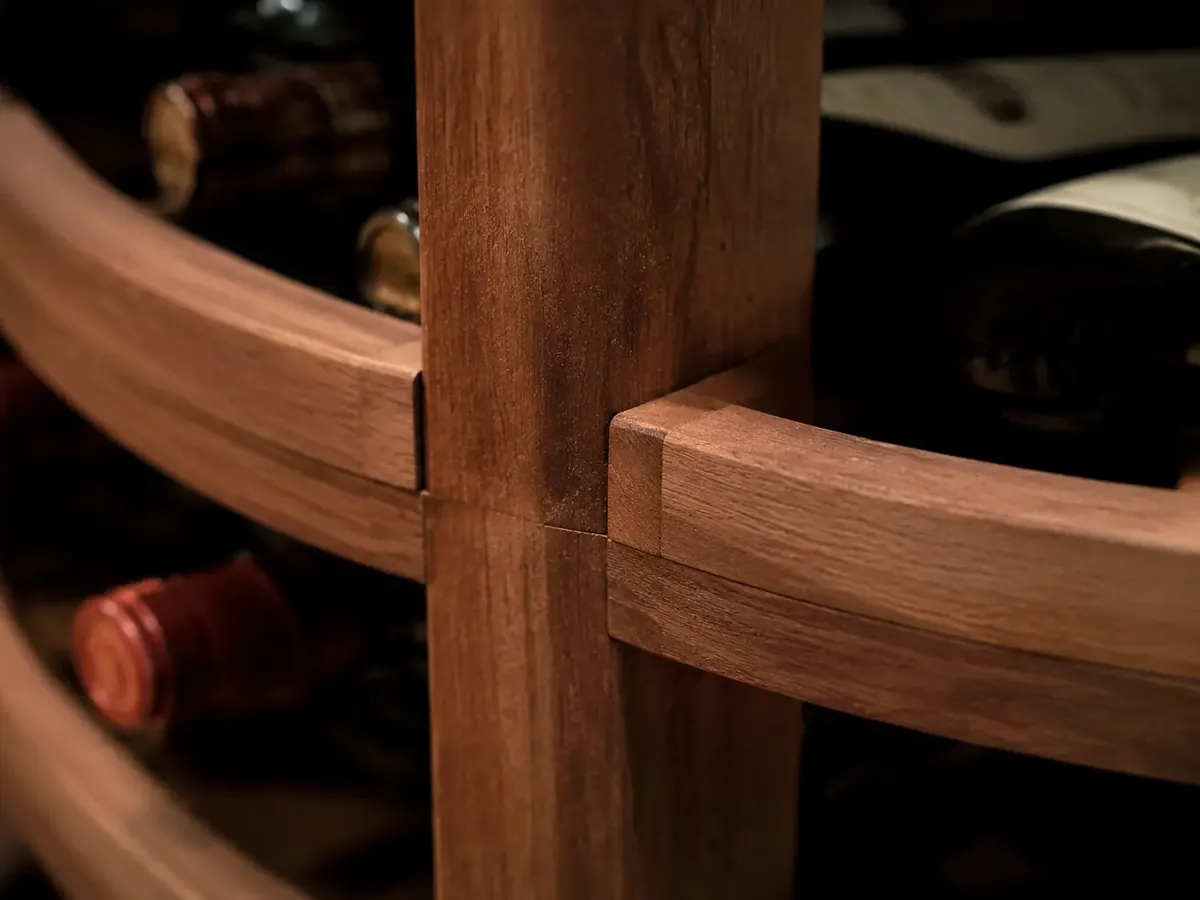
Timber specification
- Primary species
- All-heart redwood, unfinished
- Alternative
- Premium clear western red cedar
- Hardwoods
- White oak, Malaysian mahogany
- Coatings
- Water-based, zero VOC
What actually matters in timber racking
Timber racking is judged over decades. The species and the finish decide whether it still looks and smells right in twenty years, and both decisions are made in the first week.
- Redwood grades matter considerably. All-heart redwood contains only heartwood, which carries the natural rot resistance. Sapwood-containing grades do not and will mildew at cellar humidity.
- Solvent-based finishes continue to release volatile compounds long after they feel dry, and in a sealed room with no air exchange those compounds have nowhere to go except into the wine.
- Cedar's aromatic tannins deter insects without transferring to the wine through the cork, which is a genuinely useful property in rural properties and converted outbuildings.
- Hardwood racking needs its full manufacturer cure time before loading, which for some water-based architectural coatings is considerably longer than the touch-dry time suggests.
Species drives most of the cost difference in timber racking. Redwood and cedar sit in the middle, pine at the bottom, and figured white oak or mahogany with a stained finish at the top, with a factor of two or more across that range.
Complexity is the other half. Straight runs of individual bottle racking are efficient to build. Curved corners, arched openings and integrated tasting counters are joinery, and they are priced as joinery.
Before we build your timber racking
Timber work is the most bespoke part of a cellar and benefits from decisions being made against real material rather than photographs.
- Ask to see physical samples of each species under cellar lighting rather than daylight. Redwood, cedar and mahogany all read very differently at 2700K than they do on a bright bench.
- Decide whether you want the timber to age or stay consistent. Redwood and cedar both darken noticeably in the first two years, and some clients love that while others are surprised by it.
- Confirm the cellar will be at operating temperature and humidity before racking is delivered. Timber acclimatises before installation, and installing dry timber into a 60 percent humidity room causes movement.
- Allow cure time in the schedule for any stained work. This is the most commonly compressed part of a build and the one where compressing it has the longest-lasting consequence.
Timber choice affects the whole cellar budget.
Our cost guide shows where species selection sits relative to the other decisions you will make.
How your custom wood wine racking project works
Select species together
We show you physical samples under cellar lighting so the species choice is made against how it will actually look in the room.
Draw and cut to survey
Racking is drawn against surveyed dimensions and cut in the shop, including any curved or angled sections.
Acclimatise
Timber is delivered into a cellar already running at 55 degrees and 60 percent humidity so it settles before it is fixed.
Install and cure
Racking is installed and secured to structure, and any coated work is given its full cure before the cellar is loaded.
Custom Wood Wine Racking questions we get asked
Why is redwood left unfinished?
Because it does not need a finish to resist rot and mildew, and because any finish is something that can outgas into a sealed room. Leaving it bare removes that risk entirely.
It also means the timber ages naturally, darkening over the first couple of years into a deeper colour that most people prefer to the raw look.
Will cedar make my wine taste of cedar?
No. Cedar's aromatic compounds are not volatile enough at 55 degrees to transfer through a cork in any meaningful quantity, and cedar has been used in cellars for a very long time without that being an issue.
What we would not use is freshly milled aromatic red cedar, which is a different species and considerably more volatile. Western red cedar is the correct choice.
Do I need to be present while you install timber racking?
Not for the installation, but the species selection appointment is worth attending in person. Photographs genuinely misrepresent how timber reads under warm cellar light.
That takes about half an hour and it is the decision people are most likely to regret if it is made remotely.
Do you offer free quotes for custom wood racking?
Yes, and quotes are broken down by species so you can see exactly what upgrading from redwood to stained mahogany would cost across your specific layout.
Call 734-415-4984 to arrange a survey and a sample viewing.
Can wood racking be stained a dark colour?
Yes, in white oak or mahogany, using a water-based zero-VOC architectural stain. Dark stains work particularly well in cellars because they recede visually and let the bottles read as the subject.
Redwood and cedar are poor candidates for staining, since their natural colour and grain fight the stain and their whole advantage is being finish-free.
How do I clean and look after timber racking?
Dust it occasionally with a dry cloth and nothing else. Do not use household cleaners, polish or anything solvent-based, because all of those introduce exactly the volatile compounds we specified the timber to avoid.
If something spills, blot it and let it dry. Unfinished redwood marks and then weathers back over time.
What goes wrong, and what we do instead
Timber racking is judged over decades, and both decisions that matter are made in the first week.
| The mistake | What it causes | What we do instead |
|---|---|---|
| Solvent-based finish used | Volatile compounds outgassing into a sealed room for years | Water-based zero-VOC coatings only, or unfinished all-heart redwood |
| Sapwood-containing redwood grade | Mildew at cellar humidity, because the rot resistance is in the heartwood | All-heart redwood specified and checked on delivery |
| Racking loaded before the finish has cured | Cure interrupted, and the smell trapped in the room | Full manufacturer cure time allowed before any bottle goes in |
Timber chosen for the room, not the catalogue
Come and see the species under cellar light before you decide.